What the four items do
Dairy and beef farms buy equipment in a fairly fixed order: milk first, then handling, then feeding. Our range follows that order, so you can cost the whole yard at once.
| Item | Our range covers | Best for | Power |
|---|---|---|---|
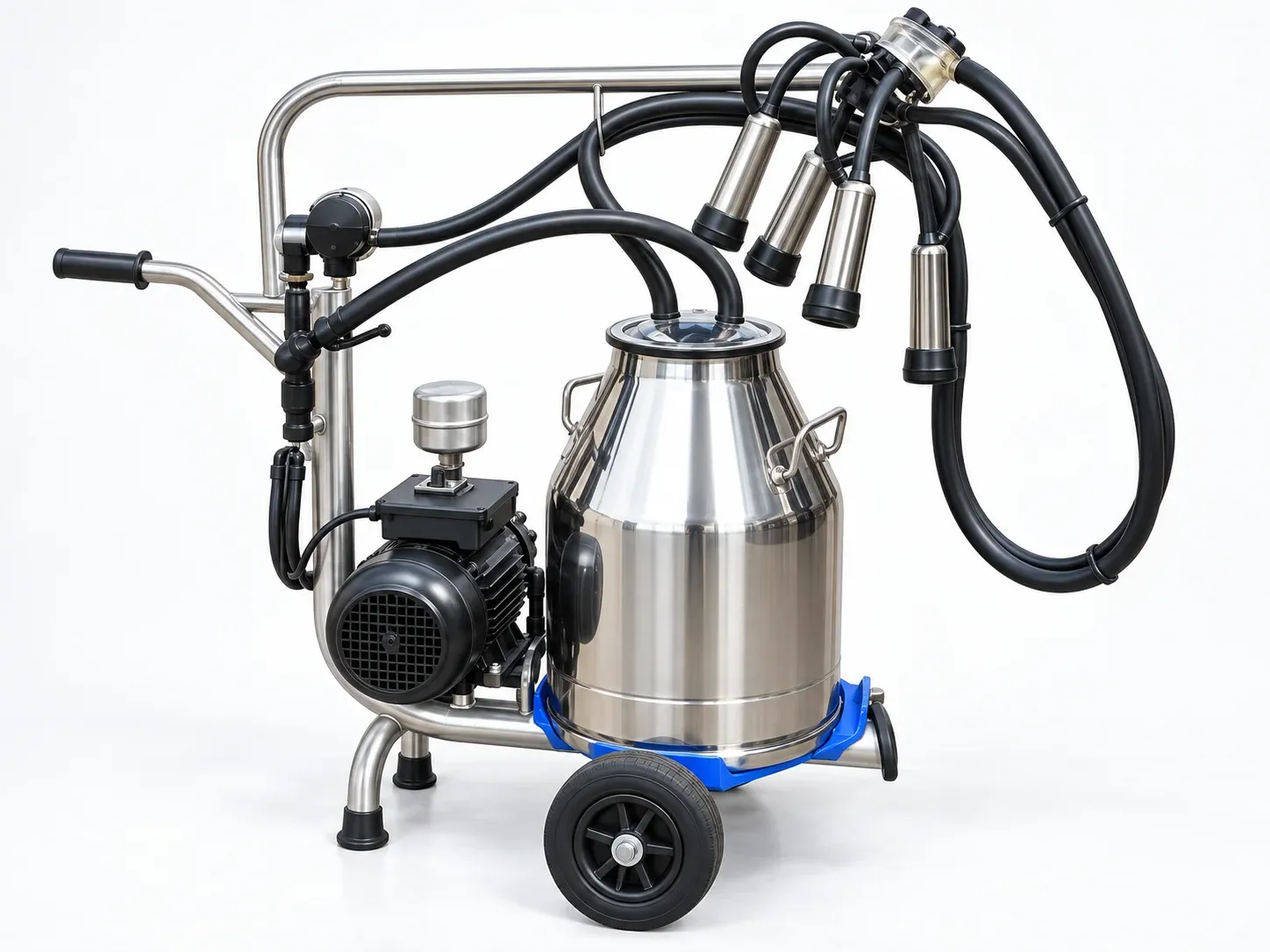
| Mobile bucket milking machine | 30 L stainless bucket on a trolley; single or double cow units, double goat or sheep unit; dry-vane or oil-lubricated pump | Tie-stall barns, small herds, goats, sheep | 230 V, 50 Hz, single phase |
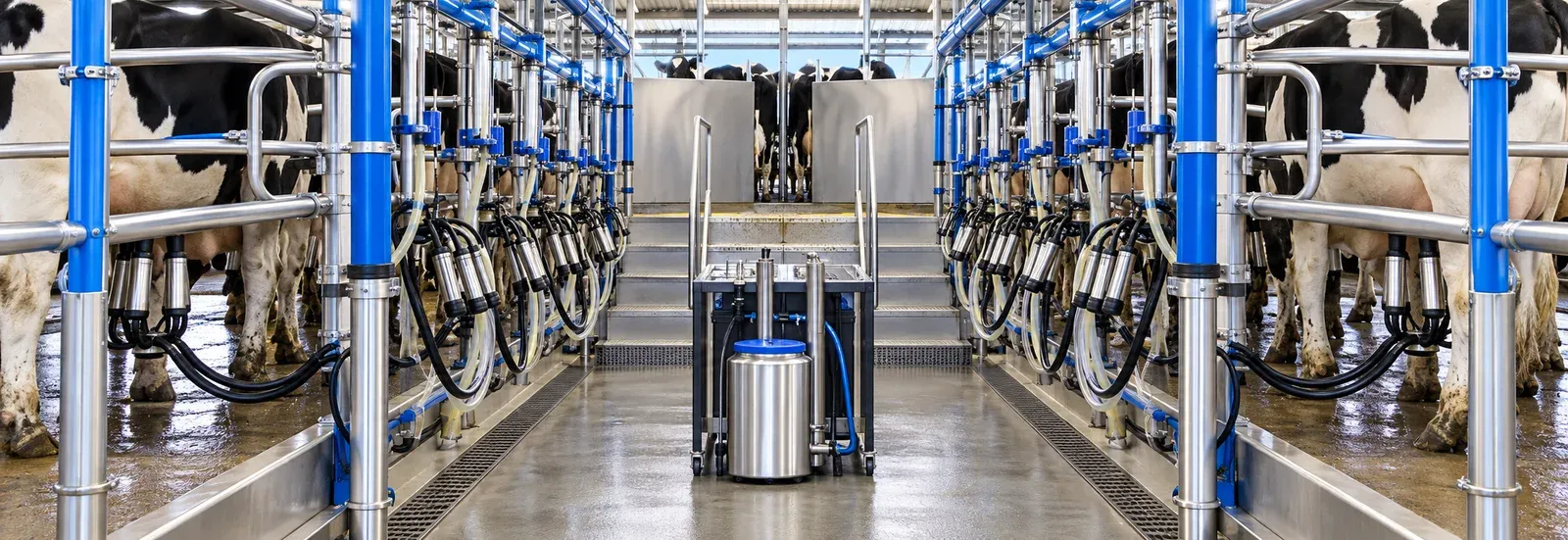
| Herringbone milking parlor | Typically 4 to 12 stalls per side, 50 mm steel tube frame, built to the shed | Herds that outgrow bucket milking | One vacuum pump station sized to the unit count |
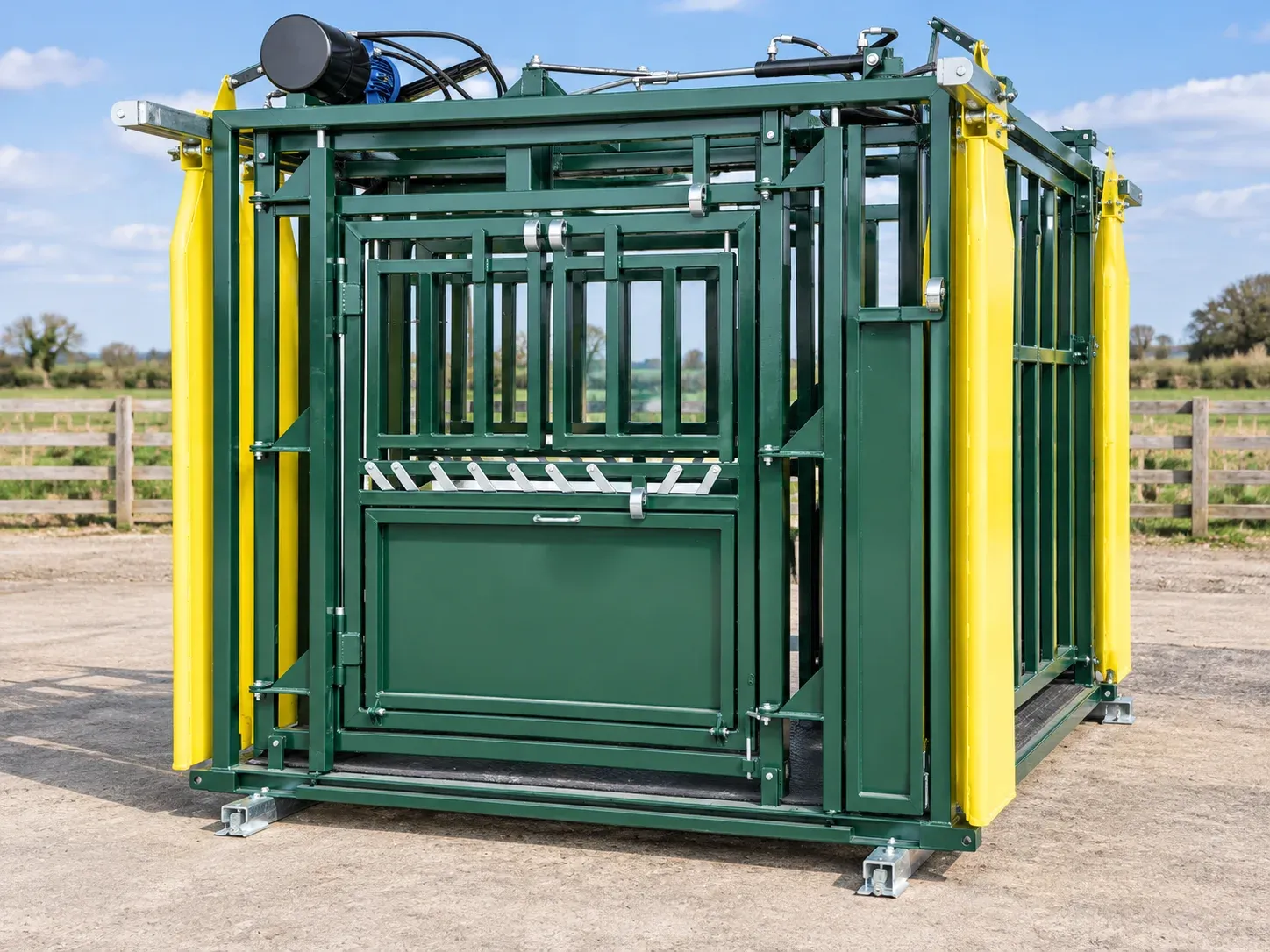
| Hydraulic cattle crush with scale | 1,500 kg weighing range, four IP68 load cells, RS232 output | Health checks, hoof work, weight recording | Hand pump, electric pump or tractor hydraulics |
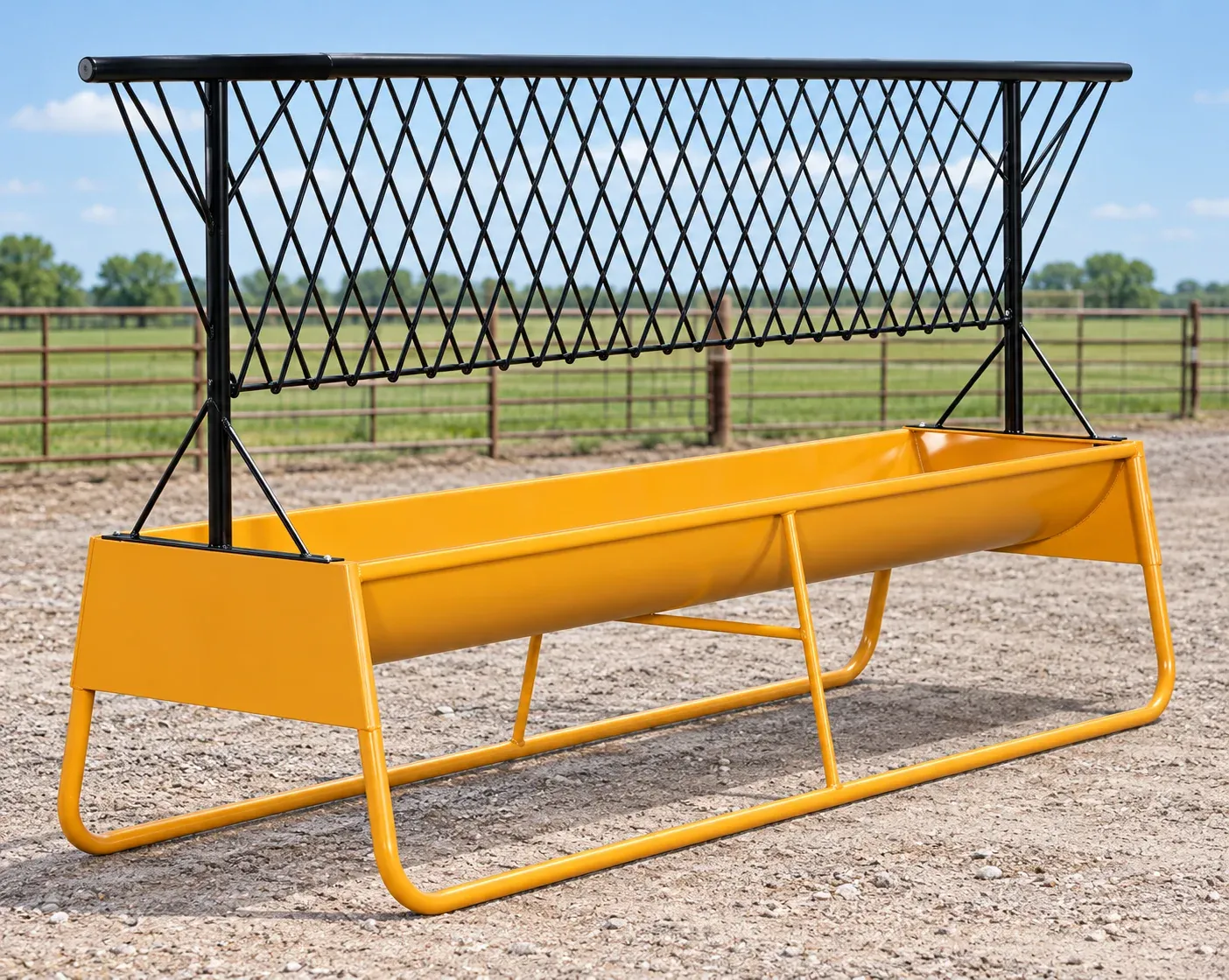
| Steel feed bunks | 3 to 4 m sections (about 10 to 12 ft), grain or silage style | Beef finishing lots, feeding lanes | None |
For the milking decision itself (bucket, pipeline or parlor, with vacuum levels and labour per cow) read our guide Cow Milking Machine: Bucket, Pipeline or Herringbone Parlor?. This page is about fitting the rest of the farm around that choice.
Sizing milking to the herd
A parlor is a labour decision as much as an equipment one. Our parlor figures are about 60 to 120 cows per hour with experienced milkers. Worked example (illustrative): 100 cows at 60 cows an hour is roughly 1 hour 40 minutes per session; at 120 an hour it falls to about 50 minutes. Run that twice daily and the saved time is the case for the parlor. Stall width is about 0.7 to 0.8 m per cow, cows stand at roughly 30 to 45 degrees to the pit, and the pit is typically 1.6 to 2.0 m wide, so the building needs to be long enough for the stall count you want, with room to extend later.
Bucket units suit the opposite end: a vacuum level of about 40 to 50 kPa and a pulsation rate of 50 to 60 cycles per minute are typical for cows (the FAO notes explain how vacuum and pulsation work). Pump motors are small (about 0.55 to 0.75 kW), so a farm with a weak supply can run them from a generator.
Handling and weighing
A good crush pays for itself in time and injuries. A UK case study of a 125-cow dairy found the time for a whole-herd task such as TB testing fell from about four hours to around one after a simple gated race and crush were installed. The race there was 700 mm wide with 1,500 mm side panels, wide enough for large cows but too narrow for them to turn. Treat those as starting points; beef breeds and horned cattle may need more.
Our hydraulic crush adds a scale, so each animal is weighed as it is restrained. Typical weighing accuracy for this kind of scale is about 0.2 to 0.5 percent of full scale, and the RS232 output feeds a herd record system. Overall length is commonly 3.0 to 3.5 m, width 0.9 to 1.1 m. Remember that the 4,000 kg shock rating is a structural limit, not the weighing range.
Feed bunk length
Example (illustrative): 200 finishing cattle that all eat together need 200 x 0.3 m = 60 m of bunk at the tight end, or 200 x 0.6 m = 120 m at the generous end. Split the herd into pens and the same arithmetic applies per pen. Steel plate of 3 to 6 mm, hot-dip galvanized or painted, handles hot climates and coarse feed; tell us about salt air or very wet silage so we advise on coating.
What to send for a quote
- Species, number of animals, expected growth, sessions per day.
- New building or an existing shed; sketch with dimensions.
- Local supply: voltage, frequency, phase, plug type.
- Maximum animal weight and whether the crush is fixed or moved.
- Feed type and lane width for bunks.
- Destination port.
If you are also planning pelleted feed for the herd, see Pellet Machines, or return to Agriculture & Livestock.