Sun, gas, or both
Drying decides whether a cocoa lot is saleable. Beans leave fermentation at roughly 55% moisture and need to come down to about 7% for storage and export. A Colombian community project described in the source below used greenhouse drying down to 10% or an oven burning propane to 7.5%, and found propane costly and hard to get. That is the central trade-off: sun is free but weather-bound, gas is steady but needs fuel supply.
| Gas-fired three-tier dryer | Solar shed with fermentation box | |
|---|---|---|
| Batch | 80 kg per chamber, 240 kg in total | about 300 kg per cycle |
| Heat | LPG or natural gas, fan-circulated hot air | Sun, in a movable half-tunnel |
| Drying time | about 24-72 hours | about 5-10 days |
| Footprint | Compact stainless cabinet | Shed about 2.5 x 6 m |
| Weather | Works in rain | Needs dry spells |
| Includes fermentation | No | Yes, three-section box |
| Suits | Buying stations, rainy seasons | Farms, co-operatives, pilots |
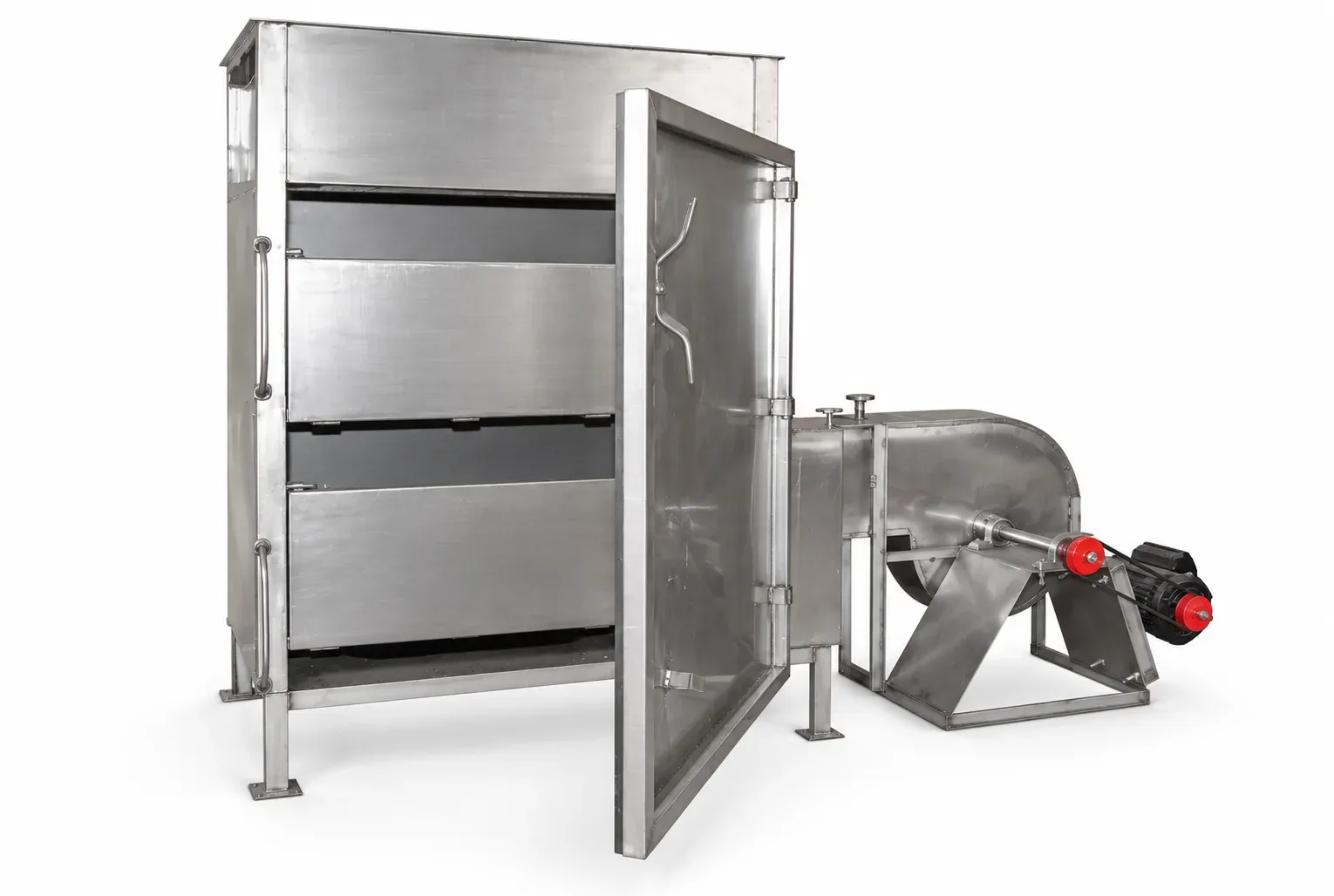
Gas-fired dryer
The three-tier stainless steel gas cocoa bean dryer stacks three chambers separated by perforated trays, with a burner and circulation fan. Beans are spread 3-5 cm deep. Food-contact stainless steel keeps the product clean, and a thermostat holds the air at a set temperature, commonly 45-60 C for cocoa. A fan of roughly 0.75-2.2 kW runs on a single-phase or three-phase supply depending on the local grid. Add a digital timer or an exhaust humidity vent if your site is humid. Gas cylinders or a manifold decide the running cost, so price LPG locally before you decide.
Dry in thin layers and turn the beans occasionally. Pushing temperature to finish faster is a common cause of case-hardened beans with a wet core.
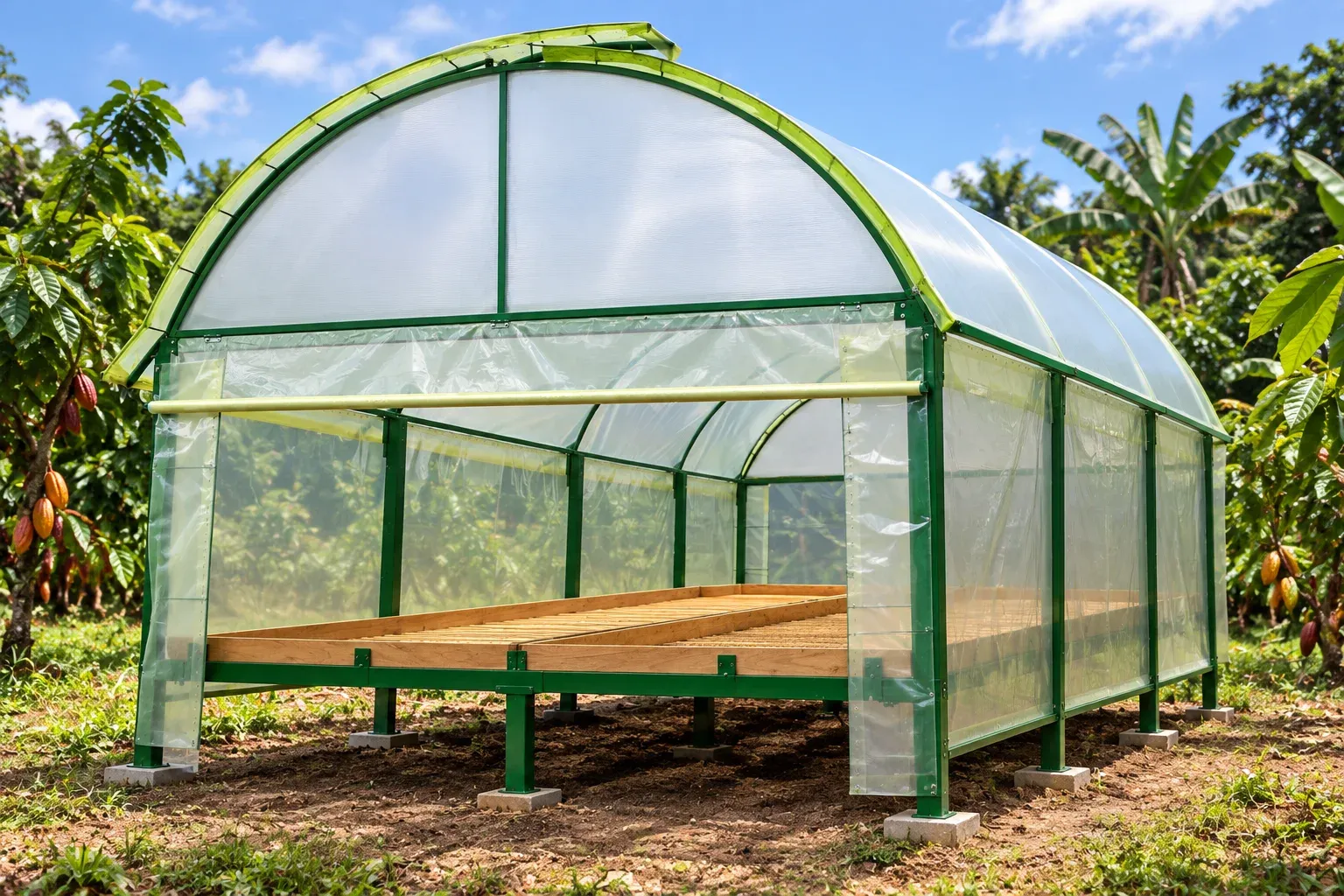
Solar drying unit
The modular cocoa fermentation box and solar dryer unit pairs a wooden three-section box with a half-tunnel shed. Fermentation takes typically 5-7 days with turning every 24-48 hours. Beans are then dried on raised racks, 3-5 cm deep, in the shed for about 5-10 days. The shed can be moved, and adding a second shed or extra box sections scales it to a co-operative.
It uses no fuel, which is why it fits remote sites and pilot projects. Its weakness is a wet harvest season.
Which one
Count your tonnes per week at peak. A 240-300 kg batch is small. Large buying stations normally run several units or a bigger plant, and we can discuss that on request. If the rainy season overlaps the main crop, choose gas or both.
What to send for a quote
- Weekly volume of fermented beans at peak
- Rainy season months and local humidity
- Gas availability (LPG cylinders or piped) and price
- Voltage and frequency
- Whether fermentation boxes are needed
- Port of delivery
For storing the dried crop, see crop storage, and the Agriculture and Livestock overview for other groups.