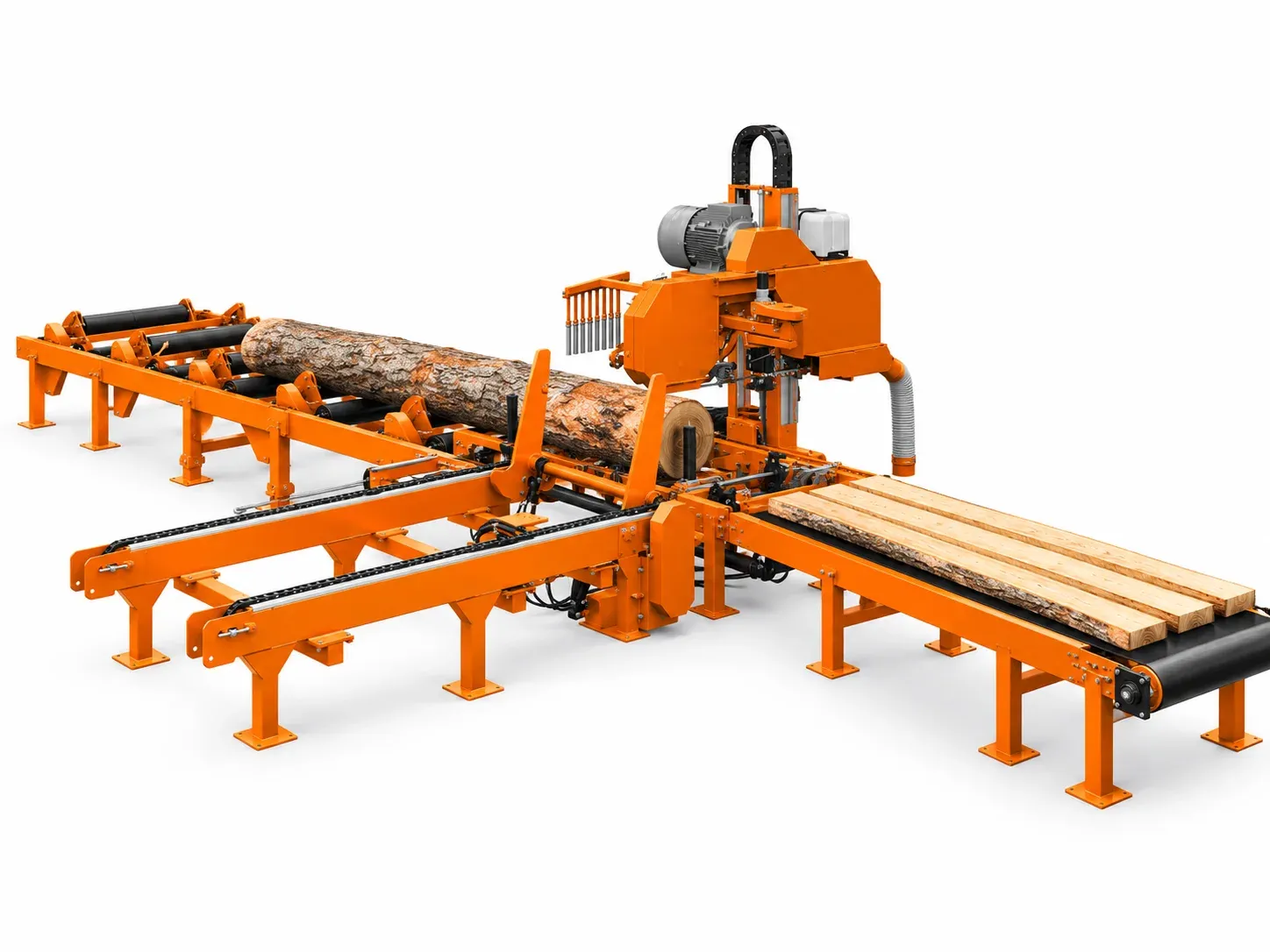
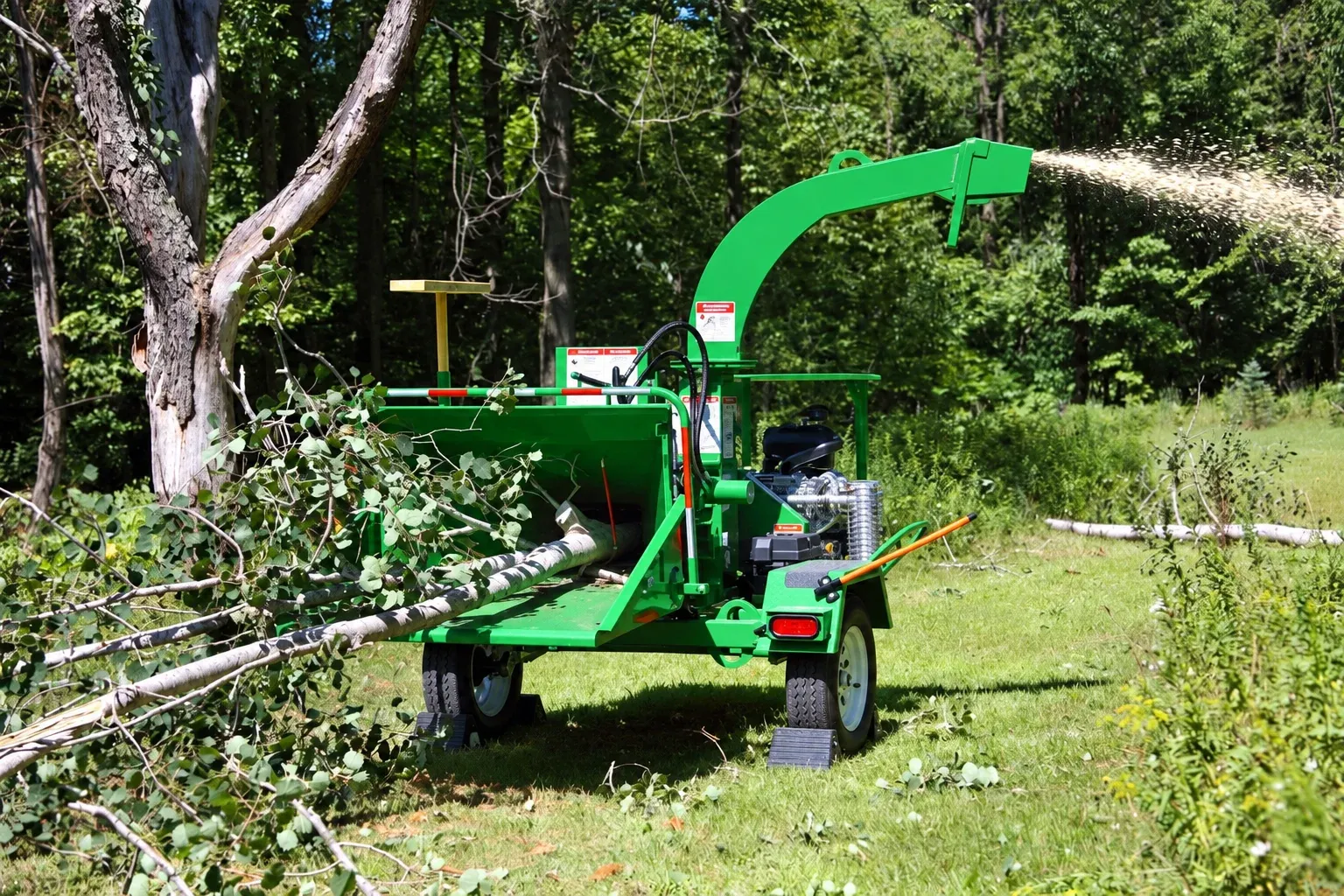
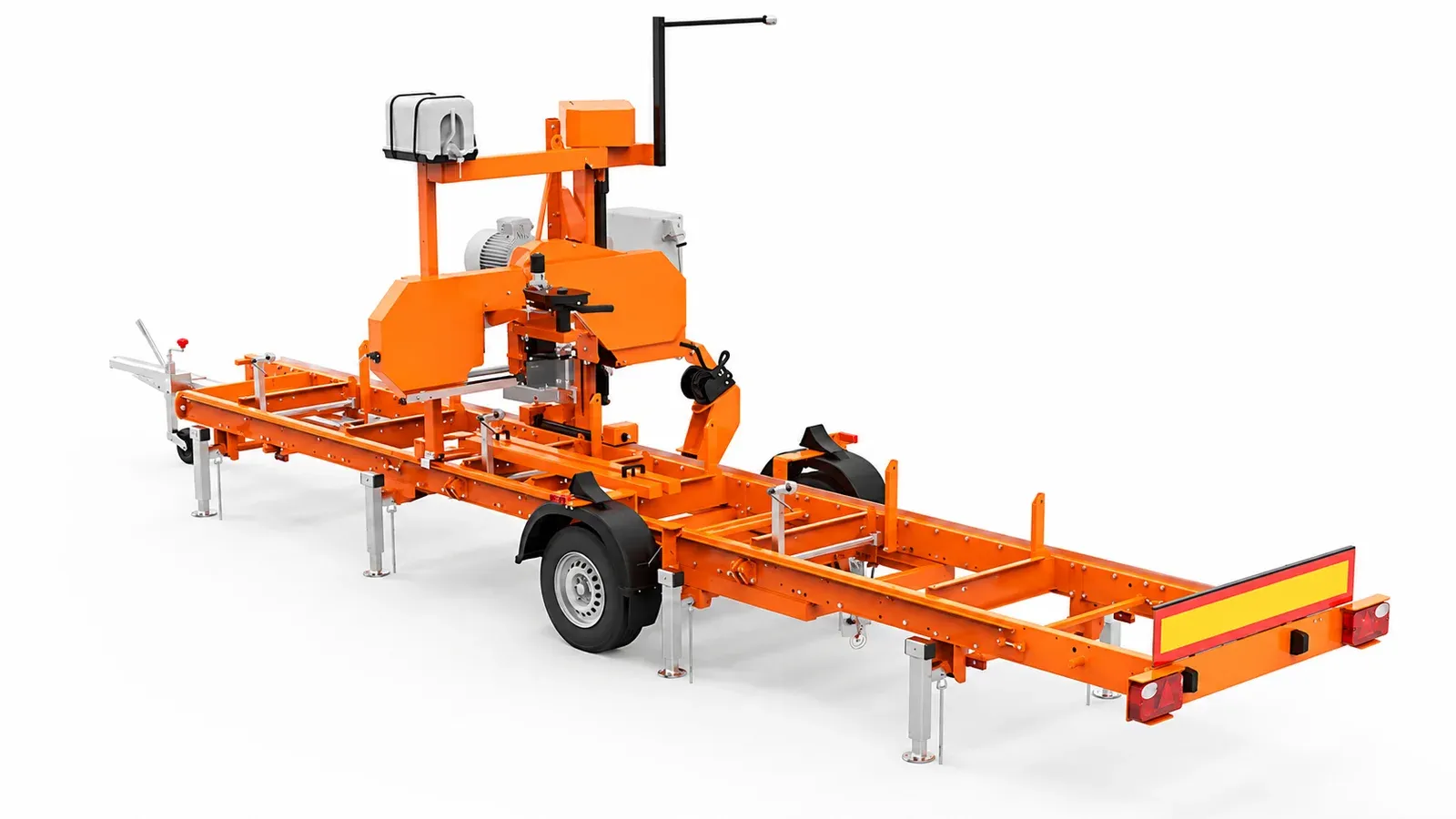
Sawmilling splits into two worlds that need different machines. In the first you bring the saw to the log: a trailer bandsaw on a woodlot or farm. In the second you bring the logs to a plant that handles them every day. Our range covers both, plus a chipper for the residue.
Three machines side by side
| Trailer bandsaw sawmill | Complete sawmill line | Disc wood chipper | |
|---|---|---|---|
| Job | Cut logs where they lie | Log deck to stacked boards | Branches and brush to chip |
| Log size | up to about 700-1,000 mm diameter | about 150-700 mm diameter, 2-6.5 m long | branches up to about 178 mm |
| Output | about 0.5-2 m³ of lumber/h | about 5-50 m³ of logs/h | about 3-8 m³ of chip/h |
| Power | petrol engine, about 15-30 kW | installed about 100-600 kW, three-phase | petrol engine, about 18-30 kW |
| Crew | 1-2 people | about 6-20 per shift | 1-2 people |
| Product page | Portable bandsaw sawmill | Sawmill line | Towable chipper |
The line figures are a range because a line is built from sub-systems: log infeed, debarking, head saw, edger, multi-saw, sorting and stacking. Board thickness runs about 15-100 mm, with sawing accuracy around plus or minus 1 mm on a line.
Deciding between a portable mill and a line
Start from the volume you must sell, not the log size. A single bandsaw handles a few cubic meters of lumber in a working day, and a line only makes sense when logs arrive every day and you can keep the head saw busy. Between the two there is a gap that many buyers fall into: a portable mill run by two shifts burns blades and labor, while a small line is expensive for a yard that sells on order. Our companion article, portable sawmill vs sawmill line, walks through that threshold with a worked example.
Bandsaws are popular for a technical reason. The thin blade removes less wood in the cut than a circular saw, so portable-mill guidance generally favors bandsaws where yield matters, as the portable sawmill overview describes. Circular headsaws cut faster but waste more fibre, so they appear in higher-volume lines.
What happens to the residue
Every log leaves slabs, edgings, sawdust and bark. The FAO publication on sawmill residues treats this as a major stream in sawmilling, so plan for it from day one. A chipper handles branches and small slabs; a line can add a sawdust and slab conveyor with a chipper. Chips go to mulch, fuel or board makers, and a buyer for them is part of the business case.
Power, climate and site
Check the supply before the machine. A line needs three-phase power matched to your grid (400 V 50 Hz in much of Africa, Europe and Asia; 480 V or 460 V 60 Hz in the Americas), and a concrete slab for the head saw. Portable mills carry their own engine, so fuel logistics matter more than the grid. In humid regions allow for faster blade and bearing wear, and for stacking and air-drying space.
What to send for a quote
- Species and log diameter range, and log length.
- Board sizes you want to sell.
- Daily or yearly output, and shifts per day.
- Preferred power: petrol, diesel or electric.
- Site layout, or the road rules for towing a trailer.
- Whether you also want a chipper or dust extraction.
Tell us those six items and we propose a mill or a line at the right scale. Paper mills and tile plants are covered in the wider industrial manufacturing range.