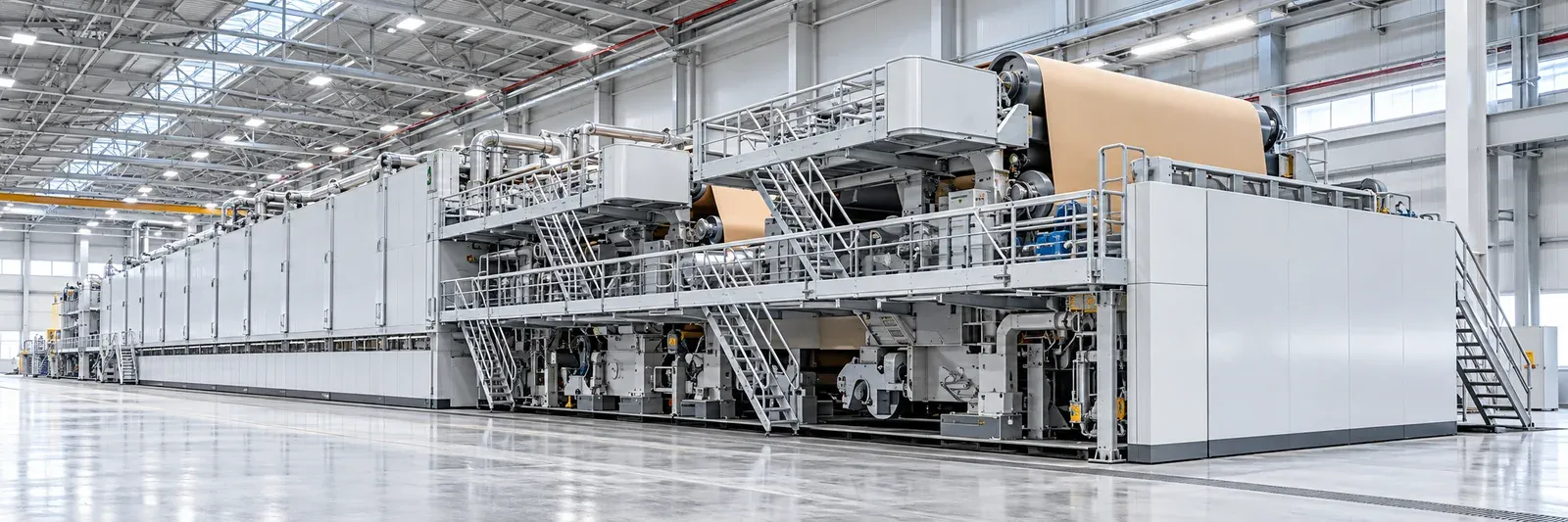
Paper machines are sold as a chain of sections, not as one box, and the sections are chosen backwards from the paper you want to make. The decisions go in this order: grade, fibre, width, tonnage, then utilities.
What our line includes
Our kraft paper and board machine page covers new lines and rebuilds, from pulper and stock cleaning, through headbox, forming, press and a multi-cylinder dryer, to calender and reeler. Options include a size press or coating section, a second headbox for multi-ply board, a rewinder and slitter, a white-water save-all, heat recovery from dryer exhaust and a quality-control scanner.
Match the grade to the machine
| Grade | Typical basis weight | Typical use | Fibre |
|---|---|---|---|
| Kraft liner | about 125-350 g/m² | outer layer of corrugated box | recycled and virgin blends |
| Test liner | about 100-250 g/m² | inner or outer layer | recycled |
| Fluting medium | about 80-180 g/m² | corrugated middle layer | recycled or semi-chemical |
| Sack kraft | about 60-120 g/m² | cement and flour sacks | virgin long fibre |
The grade bands above follow an equipment maker’s published guide (technical page); our machine’s own window is about 80-400 g/m². Light sack paper and heavy board need different press loads and dryer profiles, so a very wide window costs capacity at both ends.
Width, speed and tonnage
| Parameter | Our range |
|---|---|
| Trimmed machine width | about 1,600-5,000 mm |
| Design speed | about 100-600 m/min |
| Daily capacity | about 50-500 t/day |
| Dryer steam pressure | about 0.3-0.8 MPa |
| Steam use | about 1.2-2.2 t per ton of paper |
| Fresh water use | about 5-15 m³ per ton |
As a worked example, a 3.2 m trimmed machine at 250 m/min on 120 g/m² medium makes 3.2 x 250 x 0.12 = 96 kg/min of paper before efficiency, about 138 t per day at full uptime. At 85% efficiency that is nearly 117 t/day. The example is simplified: it only checks whether a width and speed pairing can reach your tonnage target.
Utilities decide the site
A 100 t/day mill using about 1.7 t of steam per ton needs a boiler that supplies around 7 t/h of steam for the dryers alone, plus the stock-preparation load. Fresh water at 5-15 m³ per ton means a 100 t/day mill draws roughly 500-1,500 m³ per day, so the source and effluent treatment shape the permit as much as the machine does. Many mills run 50 Hz three-phase at 380-415 V, others 60 Hz, and the drives are specified to your grid.
Recycled or virgin fibre
Recycled stock brings contaminants, so the stock-preparation scope grows: more cleaners, screens and fibre recovery. Virgin pulp needs less cleaning but a steadier supply and more refining. State the fibre mix early because it moves cost between the stock-preparation scope and the machine.
What to send for a quote
- Paper grades and basis weight range.
- Raw material: virgin, recycled or mixed.
- Required sheet width and target annual tonnage.
- Steam, water and power available at the site.
- New machine or upgrade of existing equipment.
One short email with those items is enough for a first proposal. Mills that also need wood handling or a steam plant can look at the other industrial manufacturing groups, including industrial steam generators.