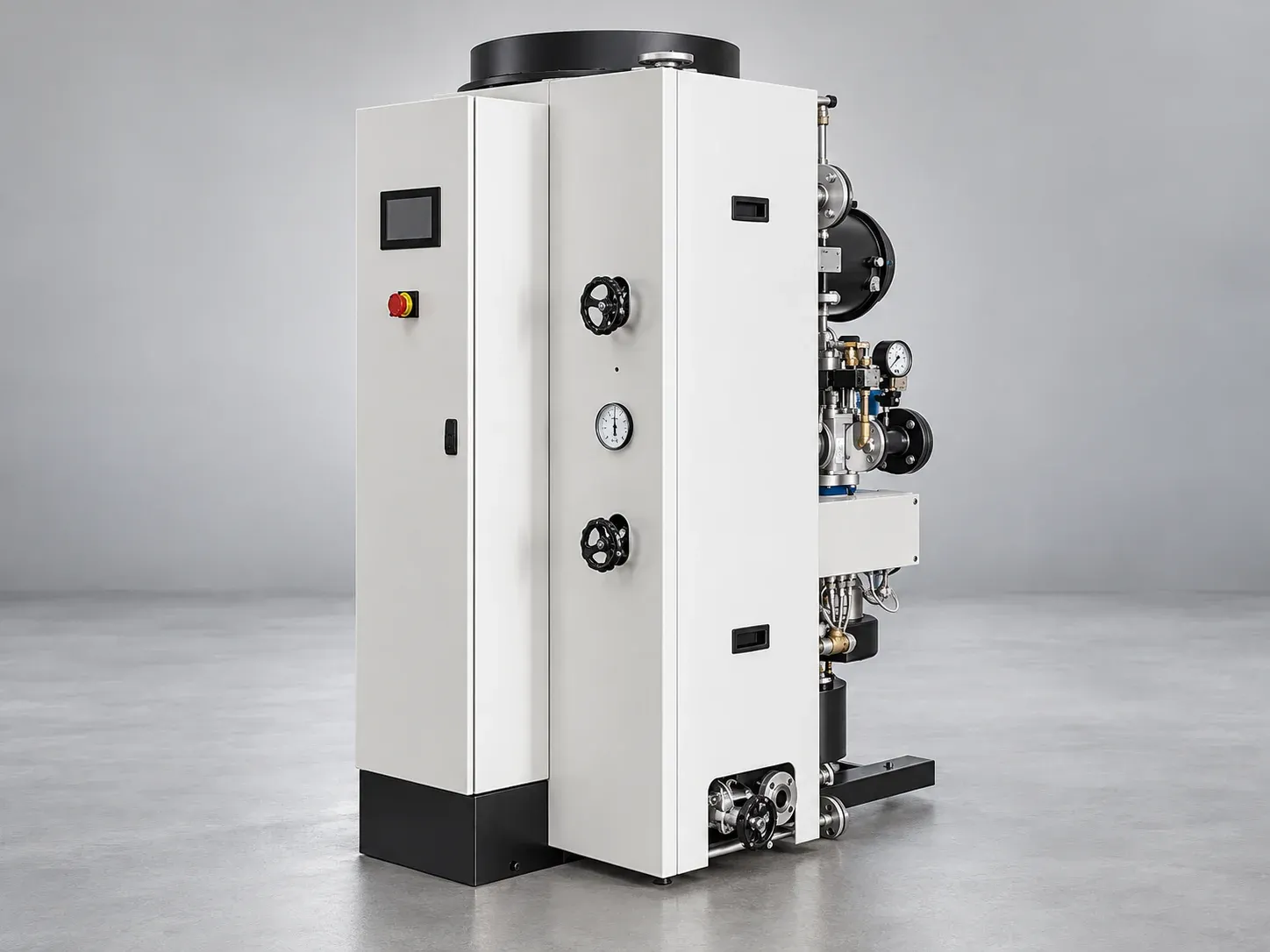
Coil generator or drum boiler
A steam generator and a steam boiler both make steam, but they are built differently. A generator pumps feedwater through one long tube coil and turns it to steam in a single pass. A drum boiler stores a large body of hot water in a pressure vessel. The coil design uses less steel, occupies less floor, and gets to steam quickly. The price is a lower turn-down ratio and a ceiling on size, which is why large plants still run drum boilers.
| Coil steam generator | Fire-tube or water-tube drum boiler | |
|---|---|---|
| Water held inside | Small (our unit: roughly 20–40 L in the coil) | Hundreds to thousands of litres |
| Time to steam | A few minutes | Typically much longer |
| Best demand pattern | Steady or batch loads, intermittent shifts | Large, swinging loads |
| Capacity ceiling | Low to mid | Very high |
| Feedwater tolerance | Low, needs softened water | Better, with blowdown |
The generator-versus-boiler guide cited below reaches the same trade-off: generators start fast but have low turn-down, so they suit a load you can describe in advance.
Our range
The MM-STG compact vertical generator covers 80–400 kg/h in several size steps, with a gas or oil burner. Typical working pressure is about 0.7–1.0 MPa, which gives saturated steam near 165–185 °C, with thermal efficiency around 88–93% (higher with flue-gas heat recovery). Electric load for the burner, pump and controls is small, roughly 1.5–5 kW, so a standard 400 V 50 Hz or 480 V 60 Hz supply is normally enough. See Compact Vertical Steam Generator, Oil or Gas Fired for the options list: softener, deaerator tank, economizer, multi-unit controller.
Sizing: a worked example
Say a laundry needs 250 kg/h at peak, with steam at 0.8 MPa and cold make-up water at 20 °C. This is an example, not a quotation.
- The heat to raise 1 kg of 20 °C water to saturated steam at that pressure is about 2.7 MJ.
- 250 kg/h × 2.7 MJ = 675 MJ/h, or about 188 kW of steam heat.
- At 90% efficiency the burner needs about 208 kW input. On natural gas at roughly 36 MJ/m³ that is about 21 m³/h at full fire.
Size to peak, but do not stack large safety margins on top. An oversized unit cycles on and off, which wastes fuel and strains the coil. If your demand swings between 100 and 400 kg/h, two smaller units sequenced together usually beat one large one. Also state the basis of any steam rate you quote: gross and net steaming rates differ once you heat feedwater and blow down, as the second source below explains.
Fuel, water and site notes
- Fuel. Natural gas, LPG or light diesel. Check gas supply pressure and pipe size, or the fuel storage if you burn diesel.
- Feedwater. Softened water with near-zero hardness is the single biggest factor in coil life. Plan for blowdown and a yearly inspection and chemical clean.
- Climate. Hot, humid sites need a ventilated plant room; cold sites need frost protection on feed and condensate lines.
- Approvals. Boiler rules depend on country and pressure class. Your engineer should check the local requirements; we provide technical documents for the review.
What to send for a quote
- Peak and average steam demand in kg/h, and what the steam is used for
- Required working pressure
- Fuel available on site and its supply pressure
- Water analysis, or at least hardness
- Plant room size and chimney route
- Single unit or multi-unit, and the local power supply
If you are replacing a smaller laundry or food-line boiler, send its nameplate too. The parent category is Industrial Manufacturing, and soap and detergent makers may also want the detergent and candle production group.