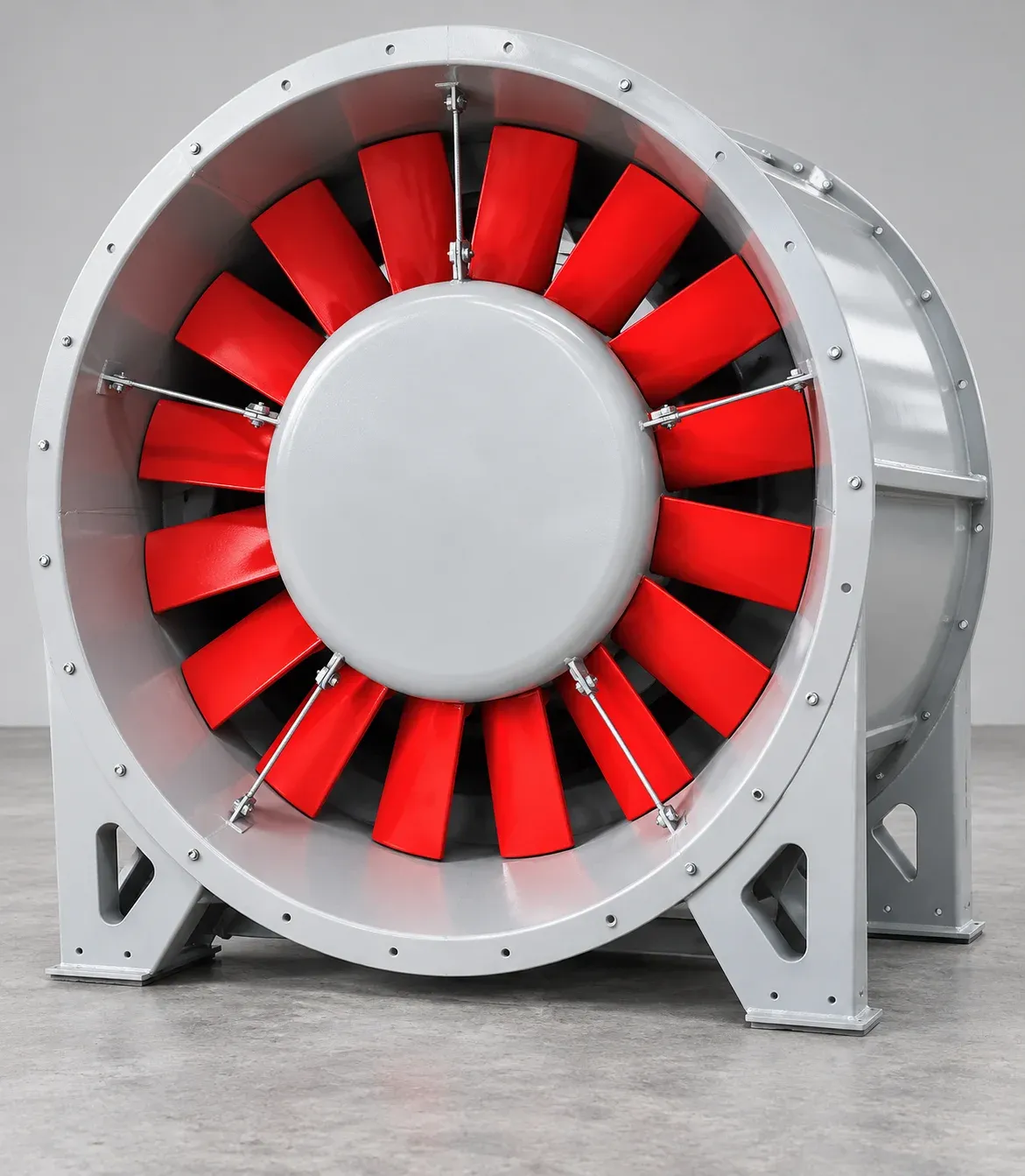
Main fans and auxiliary fans
Mine ventilation has two layers. The main system moves intake and return air through the shafts and roadways. Auxiliary fans then carry air from that flow into headings that are still being driven. Our main and auxiliary mine ventilation fan range covers both layers, so one supplier can match the fan to the duty.
The range runs from about 7.5 kW up to over 10 MW of motor power, and from roughly 600 mm to over 5,000 mm in fan diameter. Axial, centrifugal and mixed-flow designs are all available.
| Duty | Common fan type | Why | Typical sizing note |
|---|---|---|---|
| Main fan at shaft or drift | Axial, or centrifugal for high resistance | Large airflow, adjustable duty | Axial class roughly 20–300 m³/s |
| Long, narrow or resistive airways | Centrifugal | Higher pressure at lower flow | Check the fan curve at your duty point |
| Development heading with duct | Axial auxiliary | Compact, fits duct of 400–1,200 mm | Motor from about 5.5 kW upward |
| Large-opening workings | Free-standing axial or propeller | Low resistance; airflow follows momentum | NIOSH research compares these types |
Values in the last column are typical class figures, not fixed ratings.
Start with the duty point
A fan is chosen at a point on a curve, not by a diameter. You need:
- Airflow (m³/s): set by the number of people, diesel equipment, gas emission and dust at the workings, and by your regulations.
- Total pressure (Pa): the sum of friction in roadways and duct, leakage and shock losses. Longer duct means more pressure, so an undersized duct often wastes more than an undersized fan.
- Operating range: the mine resistance changes as it extends. Adjustable blade pitch or variable-frequency speed control lets one fan follow that change.
Total efficiency at the design point is typically around 75–88 %, so a fan operated far from it costs real power every shift.
Forcing or exhausting
Auxiliary systems either push fresh air to the heading or draw foul air out. The reference material we checked notes that care is needed to stop return air being drawn back in and recirculated. Where mine gas is present, the choice and the electrics must be set by the mine’s ventilation officer under local rules.
Power, noise and monitoring
Main fans are large electrical loads, so confirm the supply voltage and frequency early; the starter or control cabinet is part of the scope. Variable-frequency speed control also reduces the starting current and lets you turn the fan down in quiet periods. Noise is controlled with silencers on the inlet and outlet, and the permitted sound level is set by your site rules rather than by us. Vibration and bearing temperature sensors, with an optional remote monitoring package, give early warning before a bearing fails. Because a stopped main fan can halt production, plan inspections around the standby unit: a full mechanical check about every six months is typical, with daily review of the monitored values.
Options that matter underground
- Explosion-protected motor for gassy mines
- Variable-frequency drive for duty changes
- Reversing mechanism or reverse air door
- Silencers on inlet and outlet
- Vibration and bearing temperature sensors
- Standby fan with changeover damper
- Duct, bends and couplings
What to send for a quote
- Airflow and total pressure required, or the roadway data to calculate them
- Main or auxiliary, and the number of units
- Roadway or duct size and length
- Gas and dust classification of the mine
- Supply voltage and frequency
- Certification your authority requires
Send this through our contact page. Related lines on the same industry page: mining safety tools and construction and mining equipment.