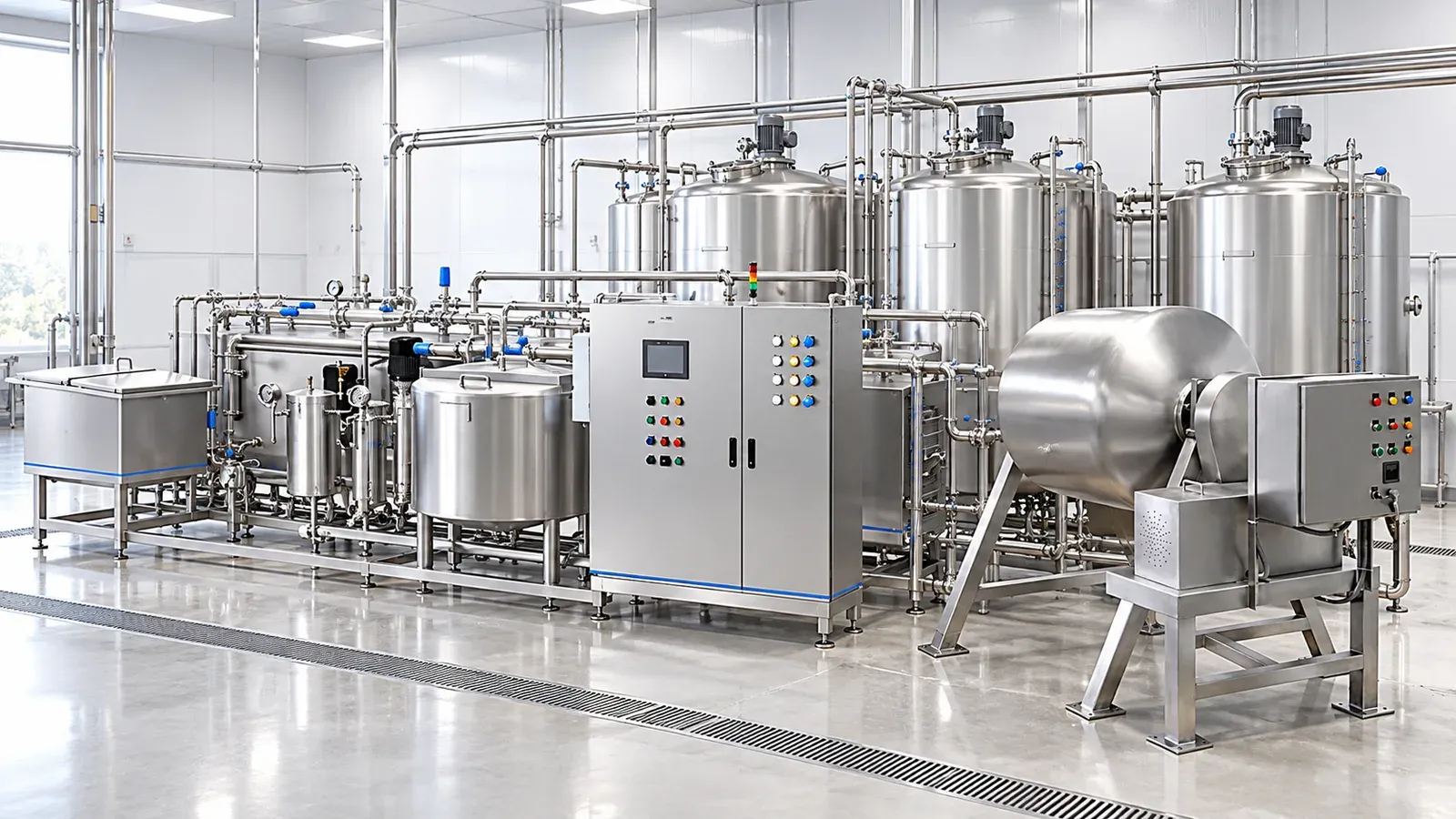
Ghee is butterfat with the water and milk solids taken out, so every ghee plant is really a butter plant with a heated kettle on the end. That is why the first question we ask is not “how many kilograms of ghee” but “what are you starting with, and how much of it arrives each day”.
Three routes into the same product
| Route | Starting material | Equipment added | Fits |
|---|---|---|---|
| Cream to butter to ghee | Separated cream, about 35-42% fat | Pasteurizer, cream tank, churn or continuous butter maker, ghee kettle | Dairies and cooperatives that collect milk |
| Butter to ghee | Bought or stored butter | Melting kettle, clarifier or settling tank, filling | Packers and ghee brands buying fat |
| Butter only | Cream | Pasteurizer, churn, optional packing and printing | Table or white butter makers |
Our cream, butter and ghee processing line is built as a custom plant on these routes. Standard equipment is a pasteurizer, cream storage tank, butter churn or continuous butter maker, ghee kettle or clarifier, CIP unit and control panel. Typical working figures for this kind of plant: cream pasteurized at 85-95 degrees C for 15-30 s, churned at roughly 8-14 degrees C, butter held to 16% moisture at most, and ghee clarified at about 105-120 degrees C to below 0.3% moisture.
Batch or continuous
A batch churn is simpler and cheaper, and it suits plants working a few thousand litres of cream a day or running several products in one shift. A continuous butter maker pays off when volume is steady and you want consistent texture without a person tipping each batch. Published figures for a compact continuous machine run from 800 to 1,800 kg of butter per hour, and one large ghee order described a plant taking 190 tonnes of cream a day, so the scale gap between small and industrial is wide. Our own line is quoted for roughly 500-5,000 litres of cream per hour, in batch or continuous form.
Worked example
Suppose you receive 10,000 kg of cream a day at 40% fat and want ghee only. At the roughly 40% by-weight yield reported for that large plant, expect near 4,000 kg of ghee a day, less your own losses. This is an illustration, so run a trial with your cream. Working 8 hours, the cream rate is 1,250 kg an hour, which sits comfortably inside the 500-5,000 litre range above and needs one pasteurizer and one kettle line.
Choosing the supporting equipment
- Separator. Needed if you start from whole milk. Skip it if cream arrives from collection centres.
- Clarifier or settling. Ghee needs the burnt solids taken off; a clarifier saves time on larger runs.
- Ripening tanks. Optional, for flavour development in cultured butter.
- Packing. Hot ghee is filled into jars, tins or pouches, and we quote the filling separately. For grated cheese, our vertical granule pouch machine runs up to 80 bags a minute.
- Cold storage. Butter needs a chilled room; see our cold room sizing guide.
Milk quality starts on the farm: our milking machine guide compares setups for dairy herds, and the herringbone milking parlor is built to the herd size. Other lines in this industry are on the food and beverage page, including filling machines.
Power and site notes
Heating can be steam or electric. In hot climates, chilled water for the churning step often decides the cooling plant size, so state your ambient temperature and water supply. Voltage and frequency are set for your country.
What to send for a quote
- Raw material (cream or butter), its fat content and daily volume.
- Products wanted: butter, ghee, or both, and the split.
- Batch or continuous preference.
- Steam, water and power available at the site.
- Packing format for butter and ghee.
- Hall size and country of delivery.
Send those six items and we will return a layout and equipment list built around your volume.