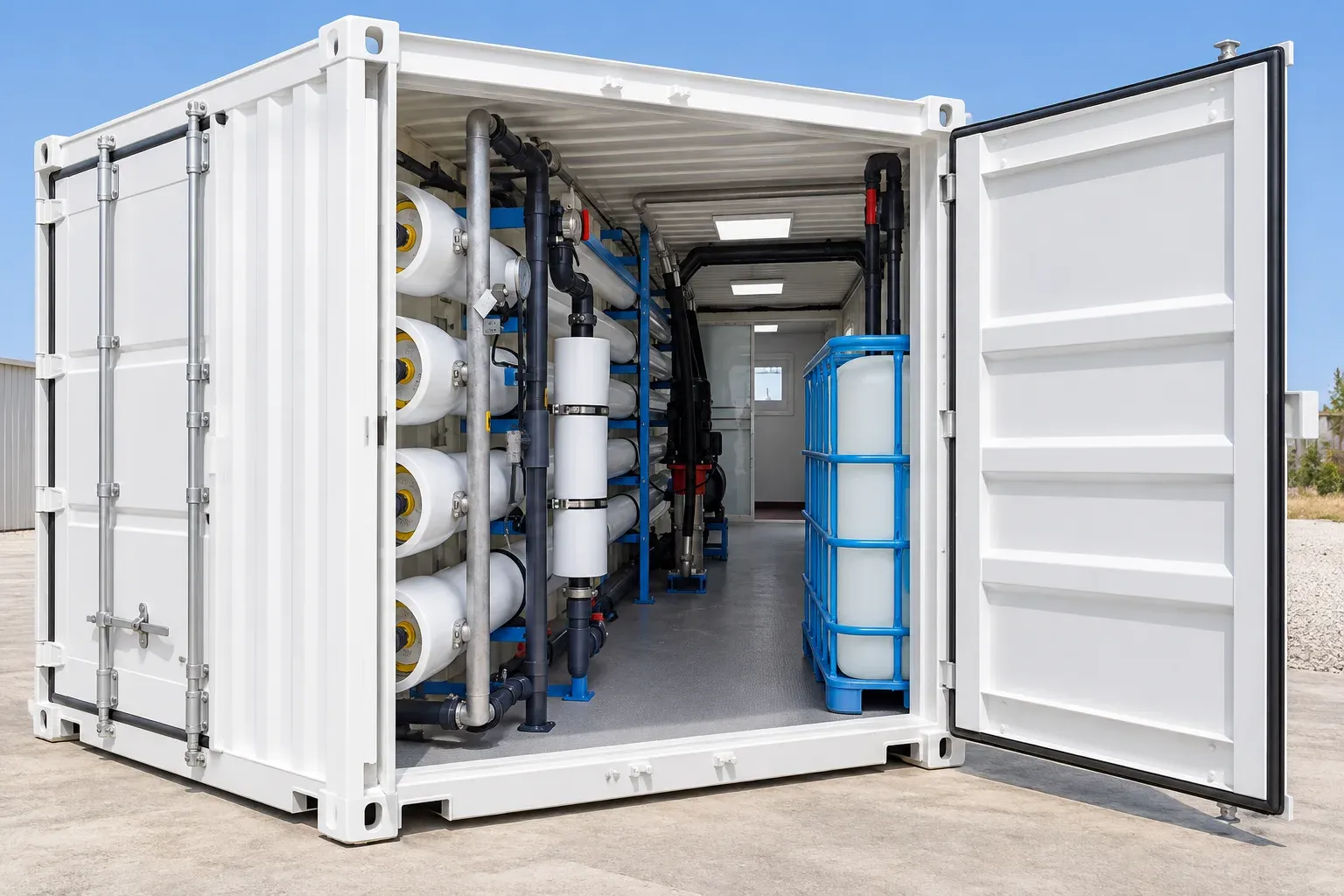
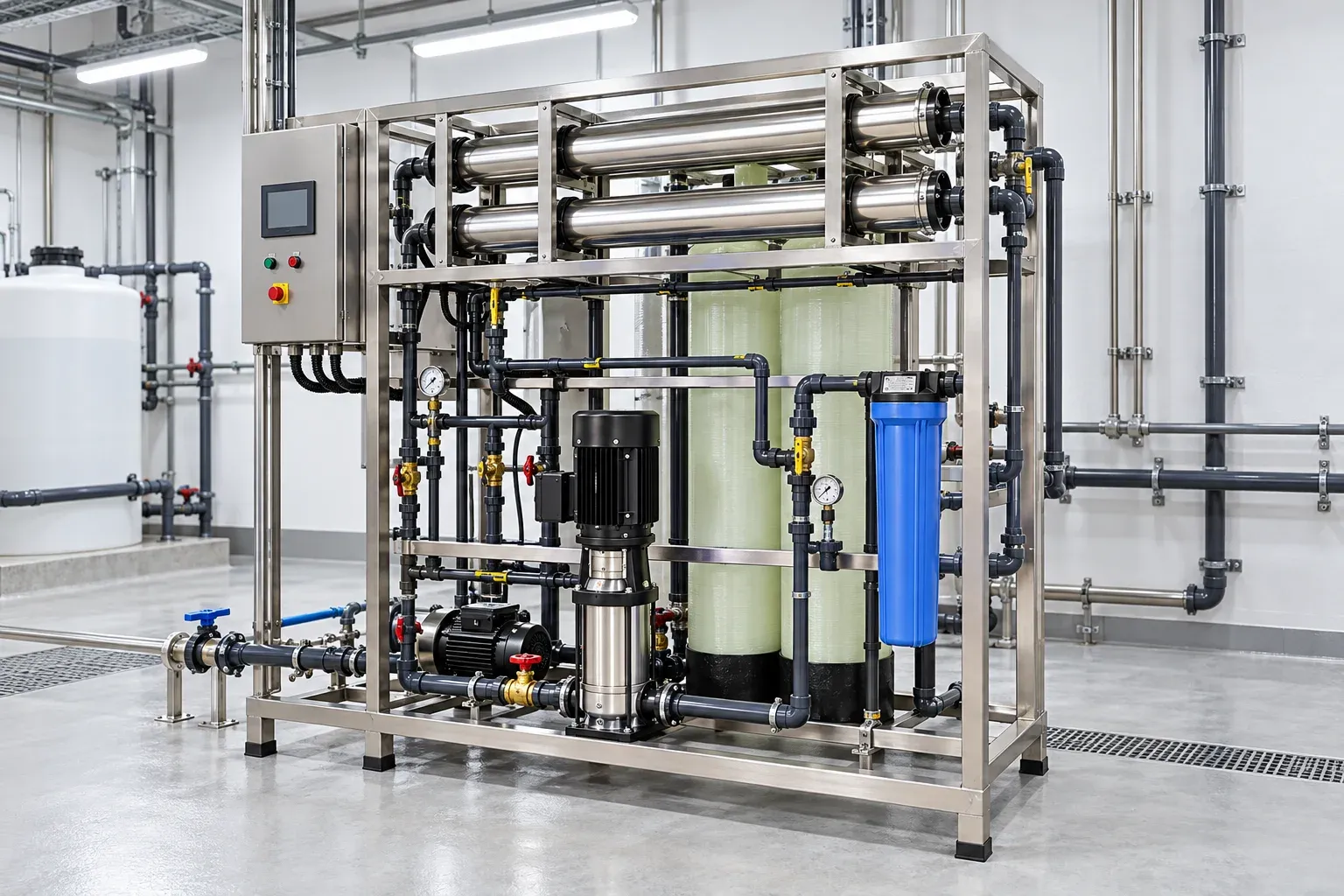
A desalination plant moves water through a semi-permeable membrane under pressure and leaves most of the salt behind. Our two products do that for brackish sources such as saline wells, coastal aquifers and inland salty groundwater. The question that matters is which package fits your flow and your site.
Skid or container
| Skid-mounted RO system | Containerized RO plant | |
|---|---|---|
| Output | about 1-10 m³/h, set by element count | 10 m³/h (240 m³/day at 24 h) |
| Membranes | 4-inch, 1-4 elements per housing | 12 x 8040 elements |
| Feed salinity | about 500-5,000 mg/L TDS | 4,000 ppm design feed |
| Recovery | about 50-75% | 70%, adjustable |
| Power | high-pressure pump about 1.5-7.5 kW | 30.2 kW installed, 15.6 kW core equipment |
| Pretreatment | 5 micron filter; feed SDI under 3 | inside the container |
| Product | Skid-mounted system | Containerized plant |
The skid arrives pre-assembled with a stainless high-pressure pump, PLC control and a cleaning connection, so it suits a pump house, a hotel plant room or a small factory. The container puts pretreatment, dosing and cleaning equipment in a 20 ft box that you connect to feed, power and a product tank.
Why brackish is not seawater
The energy bill follows salinity. At the container’s design point the specific energy is 1.56 kWh/m³ with pressure normally about 10-16 bar. Seawater, at roughly ten times the salt of our design feed, needs much higher pressure and a different membrane type, and costs more per cubic meter produced. If your source is truly seawater, say so at the start so the right plant is quoted. The overview of desalination methods is covered on Wikipedia; for sizing a brackish plant step by step, use our RO system sizing guide.
Feed water decides the design
Three numbers break most designs: the TDS, the temperature and the fouling potential. The skid asks for feed with SDI under 3, turbidity under 1 NTU, iron under 0.05 mg/L and no free chlorine, all of which can require a pretreatment stage ahead of it. Cold water lowers output; hot water raises it but shortens membrane life. Product salinity depends on the feed; at our container’s design point permeate is typically about 60-250 mg/L.
Concentrate and permits
Every RO plant produces a salty concentrate stream. At 70% recovery nearly a third of the feed leaves as concentrate, so plan where it goes before you plan the plant: an evaporation pond, a deep injection well, or a sewer if permitted. Ask the local water authority early.
Running costs and operation
A membrane plant is cheap to start and expensive to neglect. Over the years, the main running items are power for the high-pressure pump, replacement cartridge filters, antiscalant and cleaning chemicals, and eventually new membranes. Ask the operator who will run the plant: a clinic or village scheme needs an automatic system with simple alarms and a flush cycle, while a factory with a maintenance team can accept more manual control. Also ask how the plant behaves when the feed water changes in the wet season, since salinity and turbidity rarely stay constant.
What to send for a quote
- Source type (borehole, canal, coastal well) and a lab analysis showing TDS, hardness, iron, silica and pH.
- Water temperature range through the year.
- Product flow needed in m³/h or m³/day and hours of operation.
- Product use: drinking, boiler feed, irrigation or process.
- Power supply voltage and frequency, and site conditions.
- Concentrate disposal route.
After treatment you will probably want storage: see water storage tanks, or the wider water treatment range for pre-treatment plants.