Start from the water, not the catalogue
Power from falling water is roughly 9.81 x flow (m³/s) x head (m) x efficiency, giving kilowatts. Our 1 MW Pelton set shows the arithmetic: 300 m of head and 0.4 m³/s gives about 1,180 kW of water power, and at a realistic overall efficiency that lands near the 1,000 kW rating. The same output at 10 m of head would need around 12 m³/s, a very different machine. That is why head sets the turbine family and flow sets its size.
Which turbine for which site
General engineering sources place impulse (Pelton) machines at high head and low flow, Francis in the middle, and Kaplan or propeller types at low head and high flow. Published bands overlap, so treat them as a first filter. The table sets our six sets against the usual site description.
| Set | Rating | Head it suits | Best for |
|---|---|---|---|
| Axial flow | 100 kW | about 2–8 m | Low-head river or canal, steady flow |
| Low-head Kaplan | 200 kW | about 10 m | Low head with seasonal flow changes |
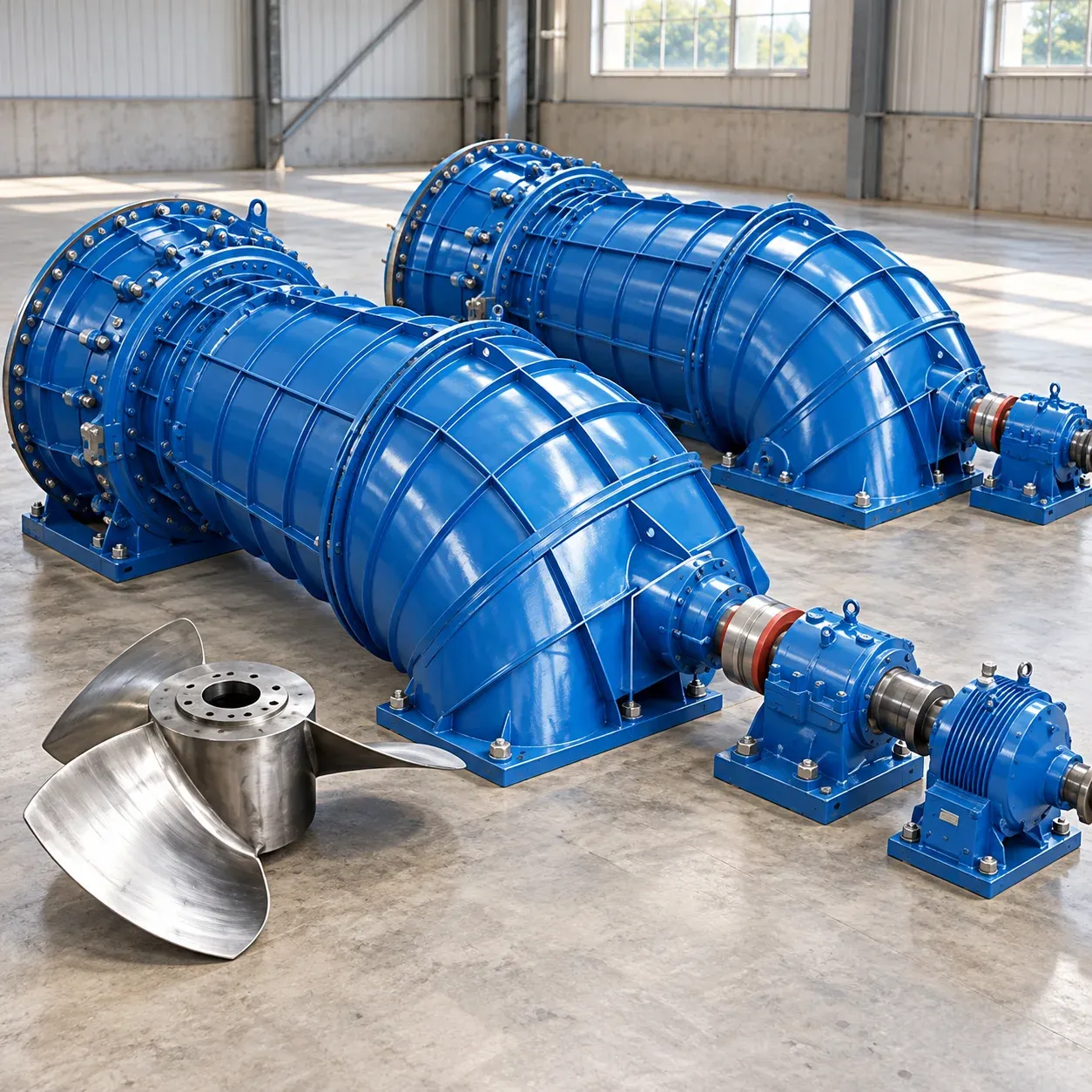
| Horizontal tubular | 500 kW | below 25 m | Low-head sites that need a shallow powerhouse |
| Francis | 200 kW (50 kW–20 MW listed) | about 20–150 m | Medium head, grid or off-grid |
| Inclined jet | 100 kW (40–250 kW listed) | 35–120 m | Medium to high head, small flow |
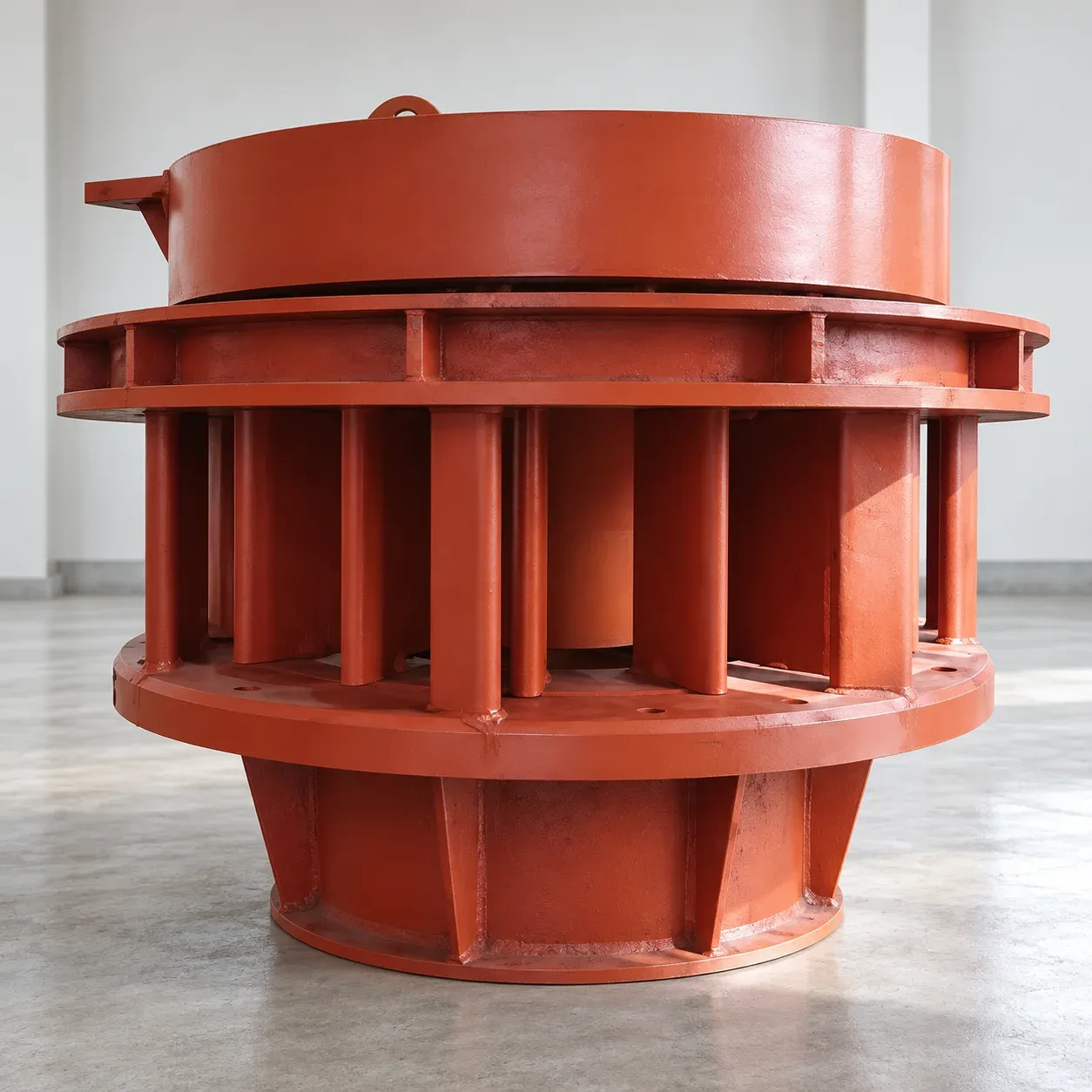
| Pelton | 1 MW | 300 m design | High-head mountain streams |
What each family asks of the site
- Low head (under about 25 m): large water volume, so intake and tailwater work dominates cost. Trash at the intake is the usual operating problem. See the 100 kW axial flow set or the 500 kW horizontal tubular turbine.
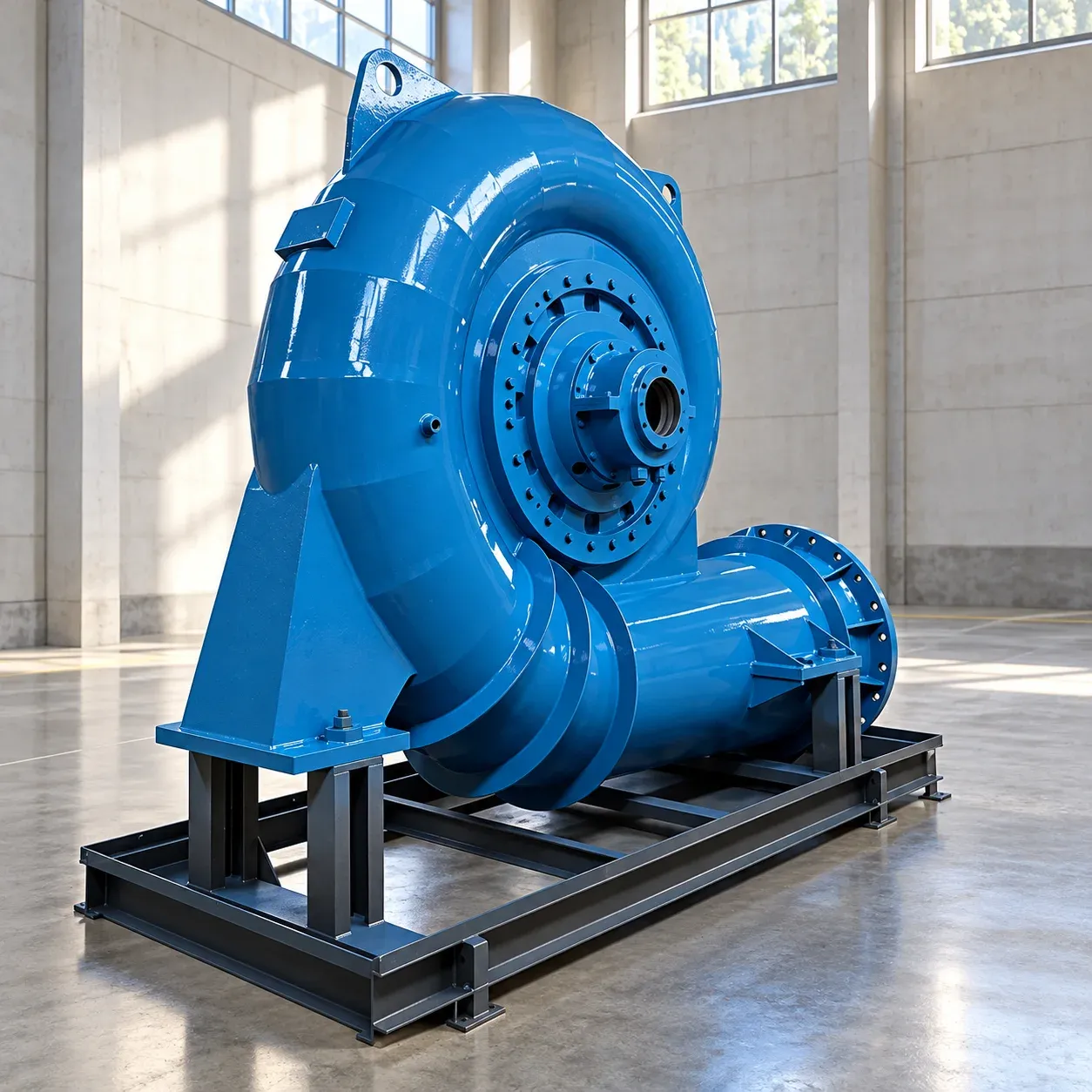
- Medium head: a penstock and a spiral case, but modest flow. The 200 kW Francis set lists voltages from 400 V to 10 kV and speeds of 150 to 1,000 rpm.
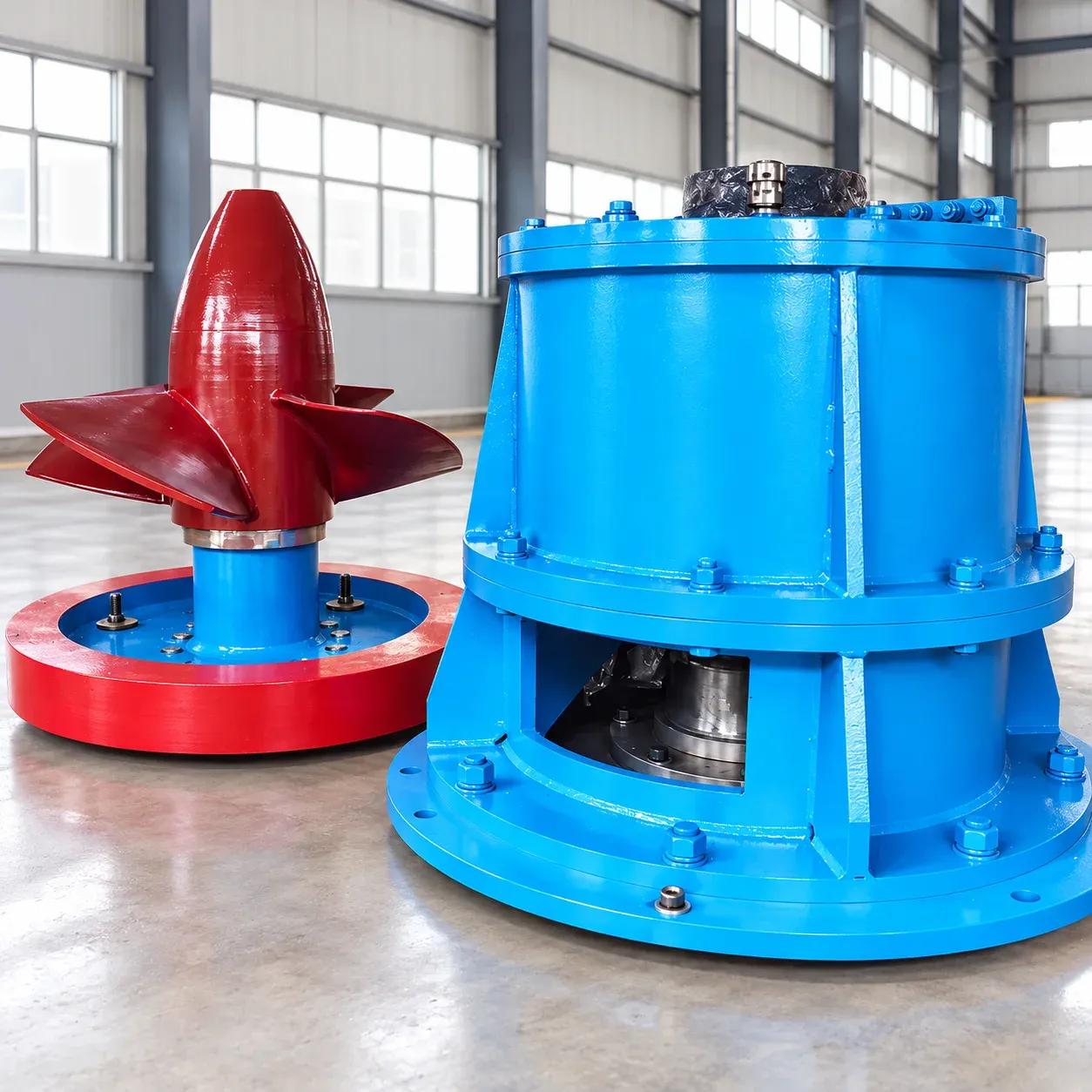
- High head: a long penstock, small pipes and a nozzle. The 1 MW Pelton set runs at 750 r/min with a stainless steel runner and brushless excitation.
Efficiency and upkeep you can expect
Peak efficiency differs by family, and our product pages give typical figures: about 88 to 93 percent for the Francis set, 88 to 92 percent for the tubular and Kaplan sets, 80 to 88 percent for the axial unit and 78 to 86 percent for the inclined-jet impulse set. Those numbers apply at the best operating point, so a site that runs far below design flow will see less. The reaction machines (Francis, Kaplan, tubular) typically call for a major inspection every four to six years. A turbine sitting in silty water wears its runner faster, which is one reason the stainless steel runner options matter on sediment-heavy rivers.
Civil works are half the project
The turbine is only part of the bill. A low-head scheme needs an intake, a flume or spiral inlet and a draft tube; a high-head scheme needs a settling basin, a penstock and an anchor design that survives surge pressure. Plan the water route and the powerhouse foundation with a local engineer while the turbine is being configured, because the flange positions and shaft level are fixed by the civil drawings.
Grid or off-grid
Off-grid village schemes need the generator to follow a changing load, so the governor and a ballast or controlled load matter more than peak efficiency. Grid-connected sets need synchronising equipment and agreement with the utility on voltage and protection. Say which one you want before you ask for a price.
What to send for a quote
- Net head and how it was measured, plus penstock length if known.
- Design flow and a month-by-month flow record or estimate.
- Grid or off-grid, voltage and frequency (50 or 60 Hz).
- Water quality: silt, sand and floating debris.
- Elevation, climate and the distance to the nearest load or substation.
For the deeper walk-through of turbine types, read our small hydropower turbine types guide. The whole power range is on the Power & Energy page, and standby power for the same site is in diesel generators.