Where the range starts
Big lab catalogues list hundreds of instrument types. We keep this group focused on the two that nearly every clinical and teaching lab buys first, and both are configured to your method rather than shipped as one fixed model.
| Instrument | Typical specification | Options | Suits |
|---|---|---|---|
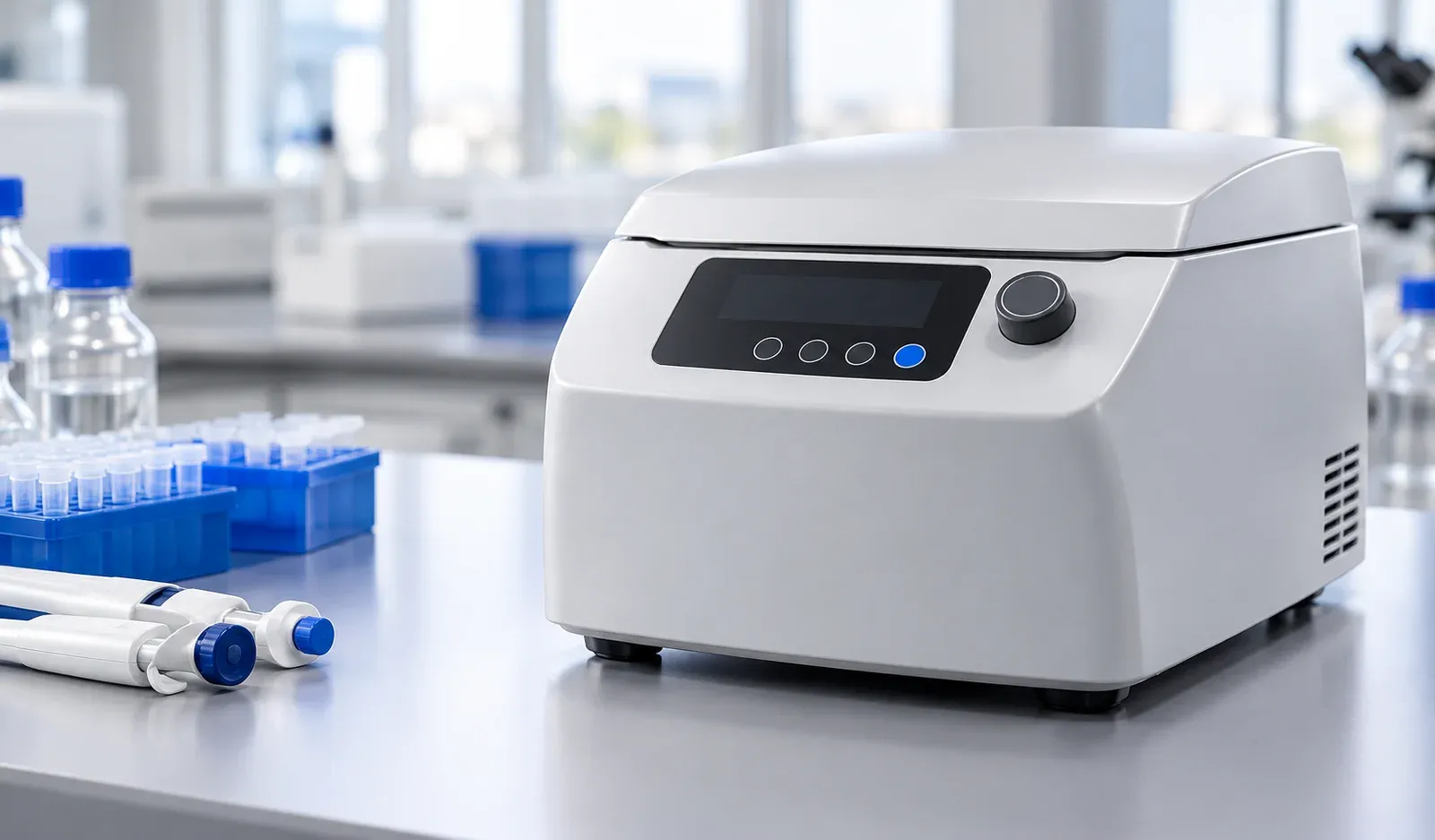
| Benchtop micro centrifuge | About 12,000 to 16,000 rpm, up to roughly 21,000 x g; 24 x 1.5/2.0 ml rotor | Room-temperature or refrigerated; fixed-angle and swing-out rotors; tube adapters | Blood and urine tubes, molecular biology, PCR strips |
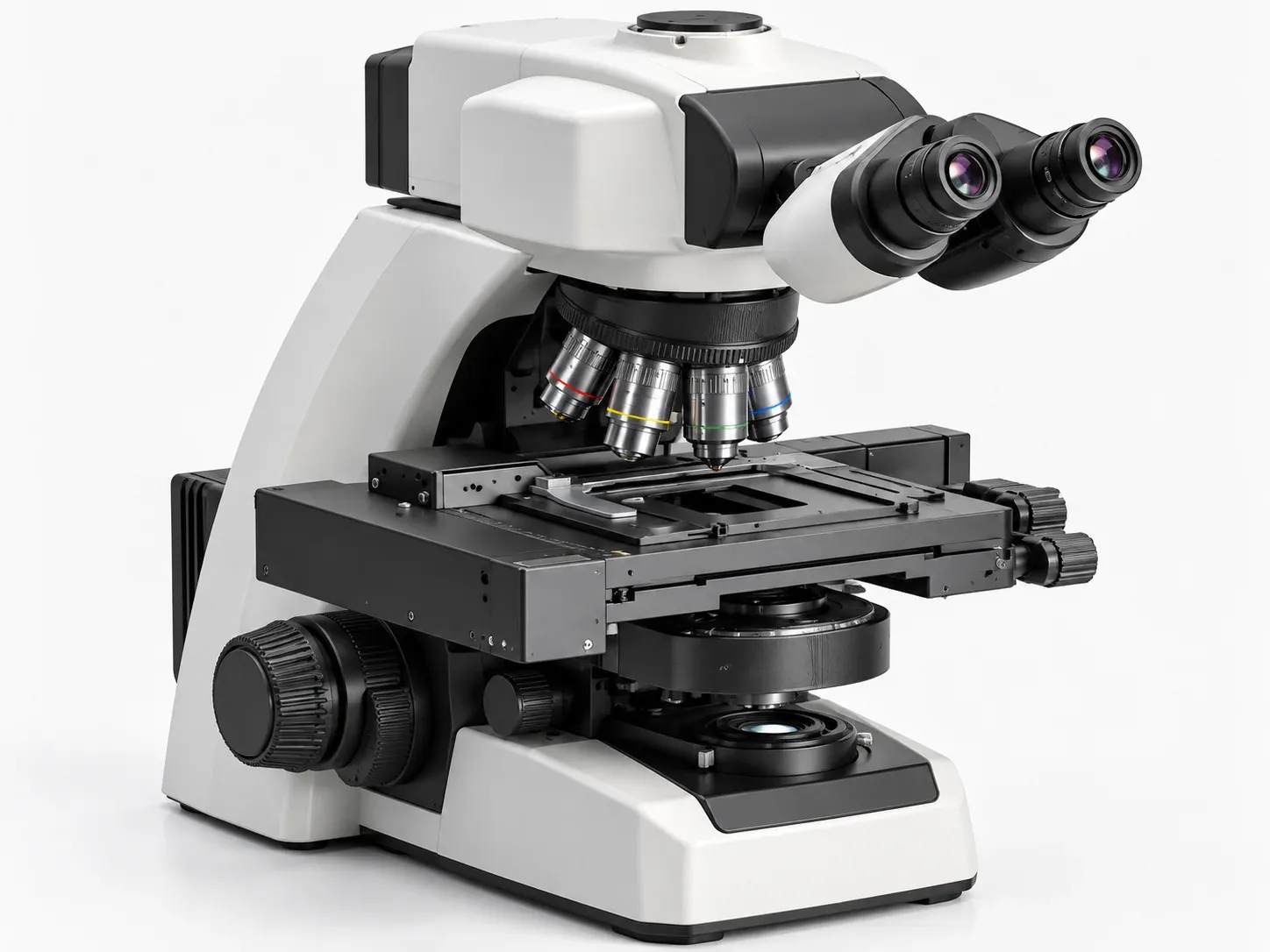
| Upright research microscope | 40x to 1,000x, up to 1,600x with fluorescence; LED light | Binocular or trinocular head, brightfield or fluorescence, camera and software | Pathology, haematology, teaching, research |
Choosing a centrifuge
Work out what you spin before you look at speed. A 1.5 ml tube rotor needs a different adapter than PCR strips, and swapping rotors changes the maximum speed you can use. Force depends on radius: RCF is about 1.118 x 10⁻⁵ x radius in cm x rpm². As a worked example, a rotor with an 8 cm radius at 15,000 rpm gives roughly 20,100 x g. That is why two machines with the same rpm can behave differently.
Refrigeration adds cost and weight, so buy it for heat-sensitive work only. Benchtop units like ours weigh about 5 to 15 kg and run below about 60 dB. Look for lid lock, imbalance detection and a soft start with brake; the standard set includes them. Always load tubes in balanced pairs, and keep spare adapters on the shelf.
Choosing a microscope
An upright microscope views slides from above. A standard set has four objectives, commonly 4x, 10x, 20x and 40x, and a 100x oil immersion objective is added for bacteria and blood films. Infinity-corrected optics make it easy to add filters or a camera later. LED illumination runs cool, and a Koehler setting gives even contrast.
Fluorescence is an add-on, not a default. If your work is routine stained slides, brightfield is enough. If you stain with DAPI, FITC or TRITC, ask for the matching filter cubes up front, because retrofitting them later means downtime.
Setting up the bench
Give the centrifuge a firm, level bench that does not share a surface with the microscope, because vibration blurs high-power images. Leave a few centimetres of clearance around the vents. Keep the microscope out of direct sun and damp, cover it overnight, and wipe oil objectives after every use. Timer settings from 10 seconds to 99 minutes, plus continuous run, cover most clinical and research protocols, so write your standard speeds and times on the lab sheet before the first run.
Practical notes for buyers abroad
- Optics and rotors ship best in foam-lined cartons. Ask for a packing list that shows rotor and adapter counts.
- Specify mains voltage, plug type and 50 or 60 Hz.
- Keep a spare LED, dust cover and tube adapters in stock.
What to send for a quote
- Sample tube sizes and how many you spin at once.
- Required speed or x g, and any temperature limit.
- For microscopes: methods (brightfield, fluorescence), stains, camera or software needs.
- Power supply and plug type.
- Number of units, and who will install and train staff.
For on-site gas supply to a lab or clinic, see Oxygen & Nitrogen Generators, or go back to Medical, Lab & Gas.