Short answer: Choose a jaw crusher when the rock is hard, abrasive or in big lumps and you need a robust first stage. Choose an impact crusher when the rock is softer and less abrasive, or when you recycle concrete and want a cubical product with fewer machines. Many mobile circuits use both, with a screen behind them.
How each machine breaks rock
A jaw crusher is a compression machine. Rock drops into a V-shaped chamber, and a moving jaw squeezes it against a fixed jaw until it fits through the gap at the bottom, the discharge setting.
A horizontal-shaft impact crusher works by speed. A heavy rotor with blow bars spins fast, strikes the rock and throws it against breaker plates. Wear rises quickly with rotor speed.
Jaw vs impact: the comparison
| Point | Jaw crusher | Impact crusher (horizontal shaft) |
|---|---|---|
| Action | Compression between two plates | Rotor strikes, rock hits breaker plates |
| Typical reduction ratio | about 3:1 to 6:1 | about 10:1 to 20:1 |
| Rock it suits | Soft to very hard, abrasive included | Soft to medium-hard, low abrasion |
| Feed size | Takes the biggest lumps for a given size | Smaller feed opening for the same output |
| Product shape | More angular, some flaky | More cubical |
| Typical stage | Primary | Primary or secondary |
| Wear parts | Jaw plates, side liners | Blow bars, breaker plates, aprons |
| Wear cost on abrasive rock | Lower | Much higher |
| Recycled concrete and asphalt | Works, but coarser product | Common choice |
| Fines and dust | Fewer fines | More fines and dust, especially on soft rock |
| Purchase price | Usually lower (simpler machine) | Usually higher for the same output |
Figures are typical values, not guarantees for any one machine. Makers disagree: some impact-crusher vendors say their machines also handle granite and basalt, while jaw-side sources call that uneconomical. Judge by your rock test and a wear-cost quote.
Feed material decides most of it
Hard, abrasive rock (granite, basalt, river gravel, quartzite). A jaw handles it with acceptable wear. A primary impact crusher starts to look expensive. The same manufacturer advises against a primary impact crusher when the feed has a Los Angeles abrasion value above 25, a Bond work index above 14.5 or an abrasion index above 0.015. Get these values from a lab first.
Soft, brittle stone (limestone, dolomite). Impact crushers work well and give good shape.
Recycled concrete and asphalt. Impact plants are the usual choice, with a magnet over the discharge to pull out rebar. A jaw is still better first when pieces are very large or heavily reinforced.
Product shape and the second stage
If your end use is concrete, asphalt or road base, shape matters. Jaw output is more angular, so a secondary impact or cone stage is normally added. A primary impact crusher can often deliver a screened, usable product by itself, but only where the rock allows it. The real decision: pay for wear on one machine, or for two machines. One impact crusher also means one engine, one set of spares and one transport, which is why some contractors accept higher wear on medium-abrasive rock. For hard rock with a cubical-stone spec, a jaw plus a cone or impact stage is the proven route.
Worked example (illustrative only)
Take a site crushing 150 t/h for 1,000 hours, or 150,000 t. Wear costs are the rough MEKA figures in euros per tonne.
| Rock | Jaw wear, EUR/t | Impact wear, EUR/t | Jaw total | Impact total |
|---|---|---|---|---|
| Limestone | 0.05 to 0.15 | 0.20 to 0.50 | 7,500 to 22,500 | 30,000 to 75,000 |
| Basalt or granite | 0.20 to 0.40 | 0.80 to 2.50 | 30,000 to 60,000 | 120,000 to 375,000 |
On limestone the extra wear is modest and an impact crusher may remove a second stage. On granite the gap is large, and a jaw followed by a cone is usually safer.
Why crawler plants, and how the line is built
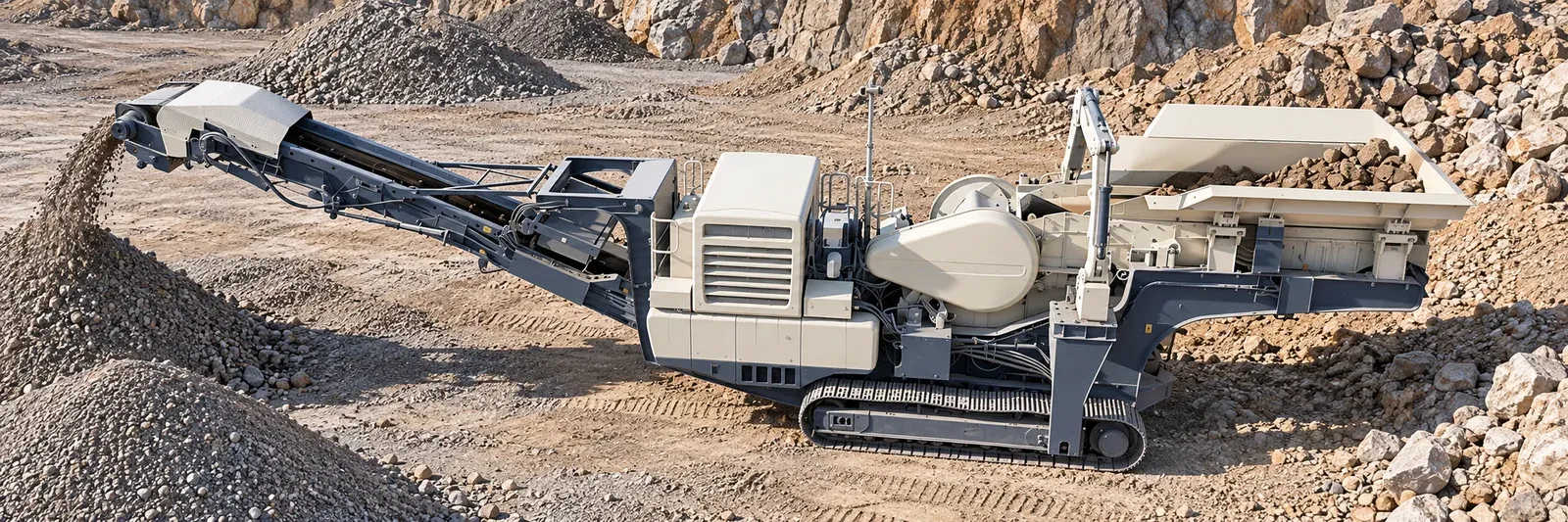
A crawler plant brings the crusher to the material: no foundations, no fixed haul route, and one operator can reposition it by remote control. That suits advancing quarry faces, contract crushing and demolition. Our crawler mobile jaw crushing plant is the primary stage: a grizzly feeder, a jaw with hydraulic setting adjustment and an under-crusher conveyor on tracks.
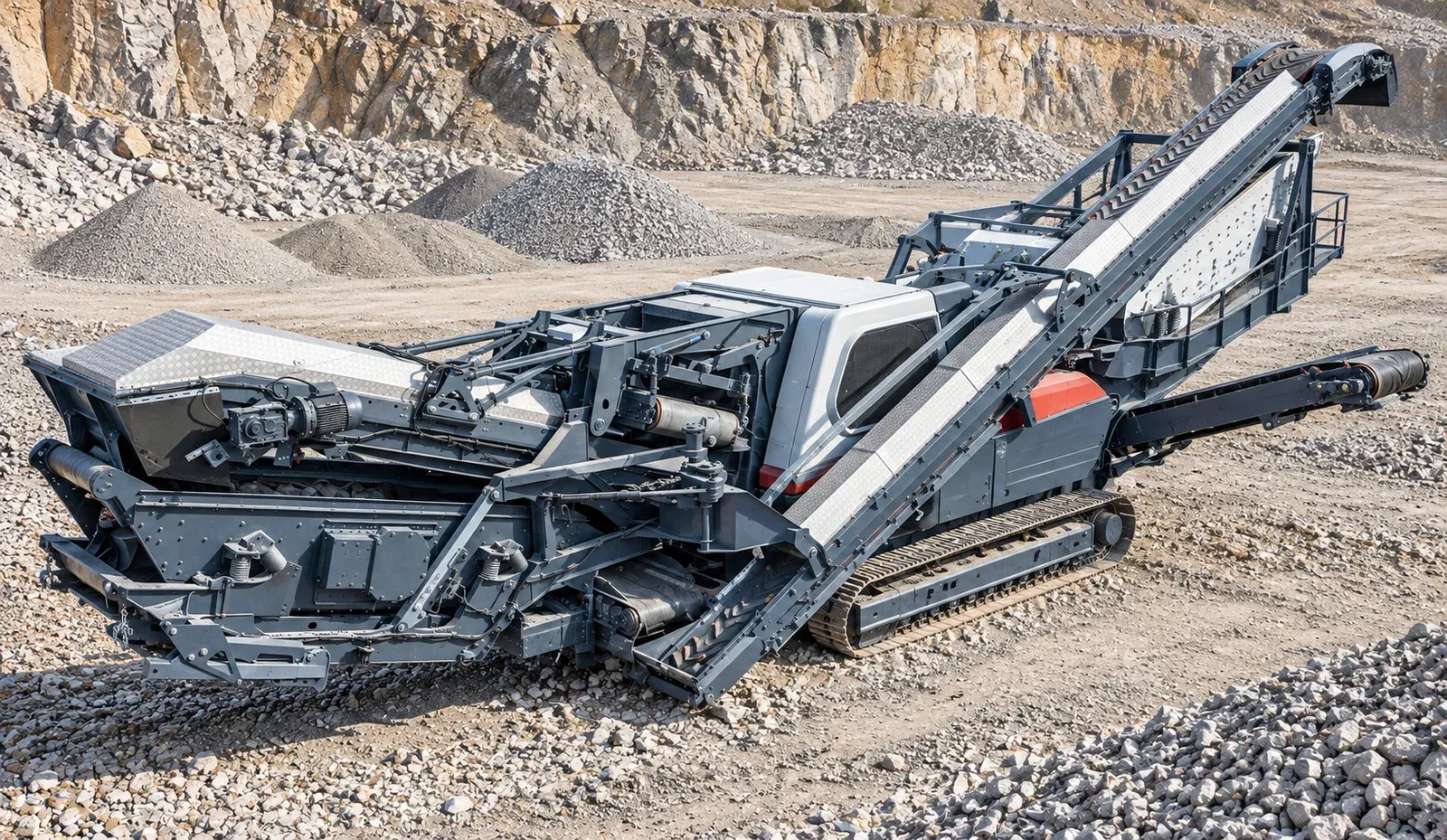
Our crawler impact crushing and screening plant puts an impact crusher, a screen and separation on one chassis. The reference setup has a 250 kW crusher drive, a 5 x 14 ft double-deck screen and a 430 kW generator set; final configuration is set per order.
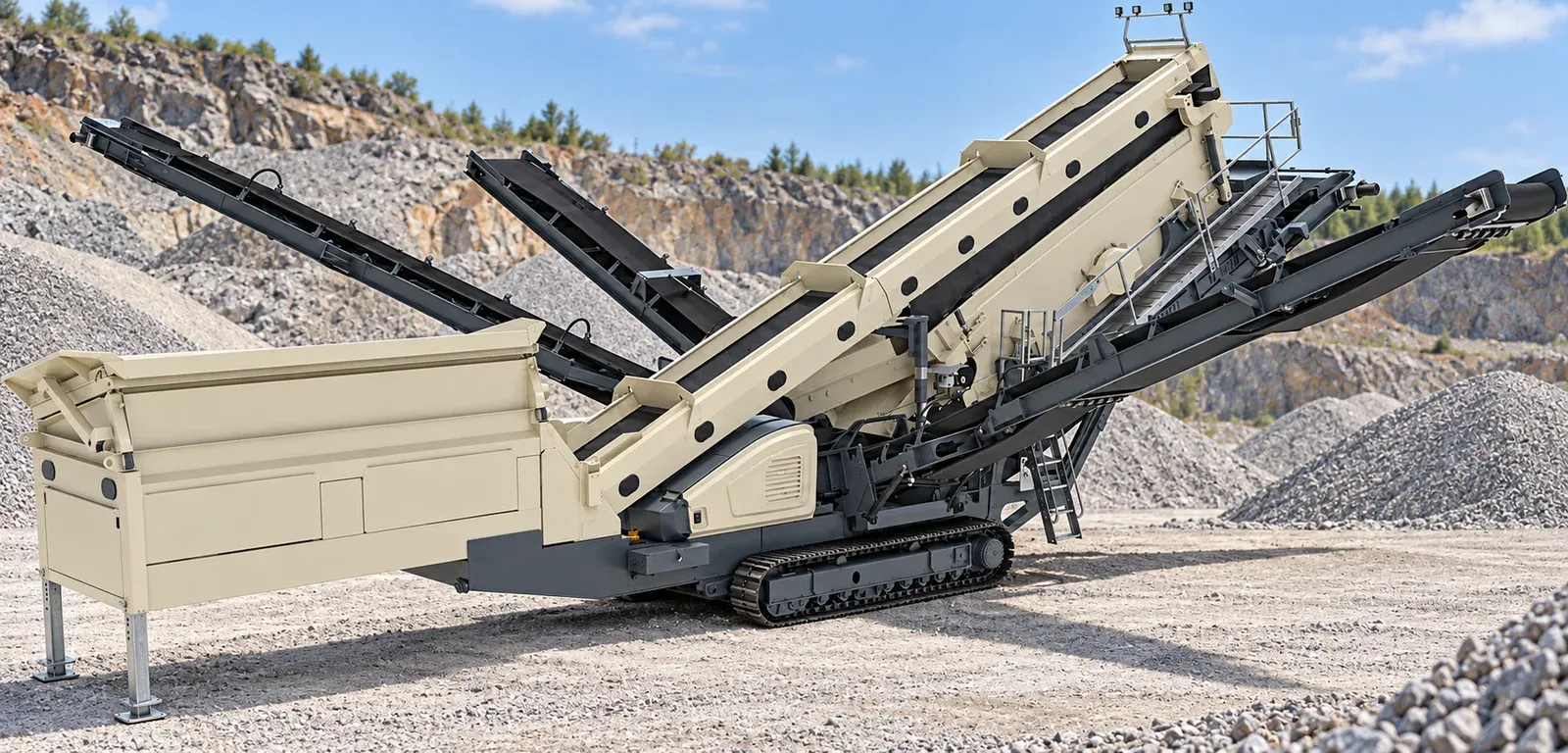
If you already own a crusher and only need grading, the crawler mobile screening plant sorts feed without reducing it. We state capacities per project, since they depend on feed and settings. More machines are listed under construction and mining; the hopper needs a loader or excavator, see how to size a mini excavator.
Honest trade-offs
- A jaw is simpler and tougher but makes a coarser, less cubical product. Plan a second stage for concrete aggregate.
- An impact crusher saves a stage but punishes you on abrasive rock, and soft feed can create excess fines and dust that need suppression. Clay or sticky feed can block either machine.
- Mobile plants pay off when you move sites or when a fixed plant would need costly foundations and haul roads.
Buyer checklist: what to tell a supplier
- Rock type and quarry or lab test values (abrasion, hardness).
- Largest lump size.
- Product sizes and hourly output.
- Share of rebar, metal or clay.
- Power at site: diesel only, or grid with voltage and frequency (for example 400 V 50 Hz or 480 V 60 Hz).
- Altitude, temperature, dust rules.
- Shipping limits: width, height, weight.
- Wear-part set price and expected life, on a quote you can compare.
If you have a rock sample and a target product, send us the details and our engineers will suggest a circuit and a configuration.