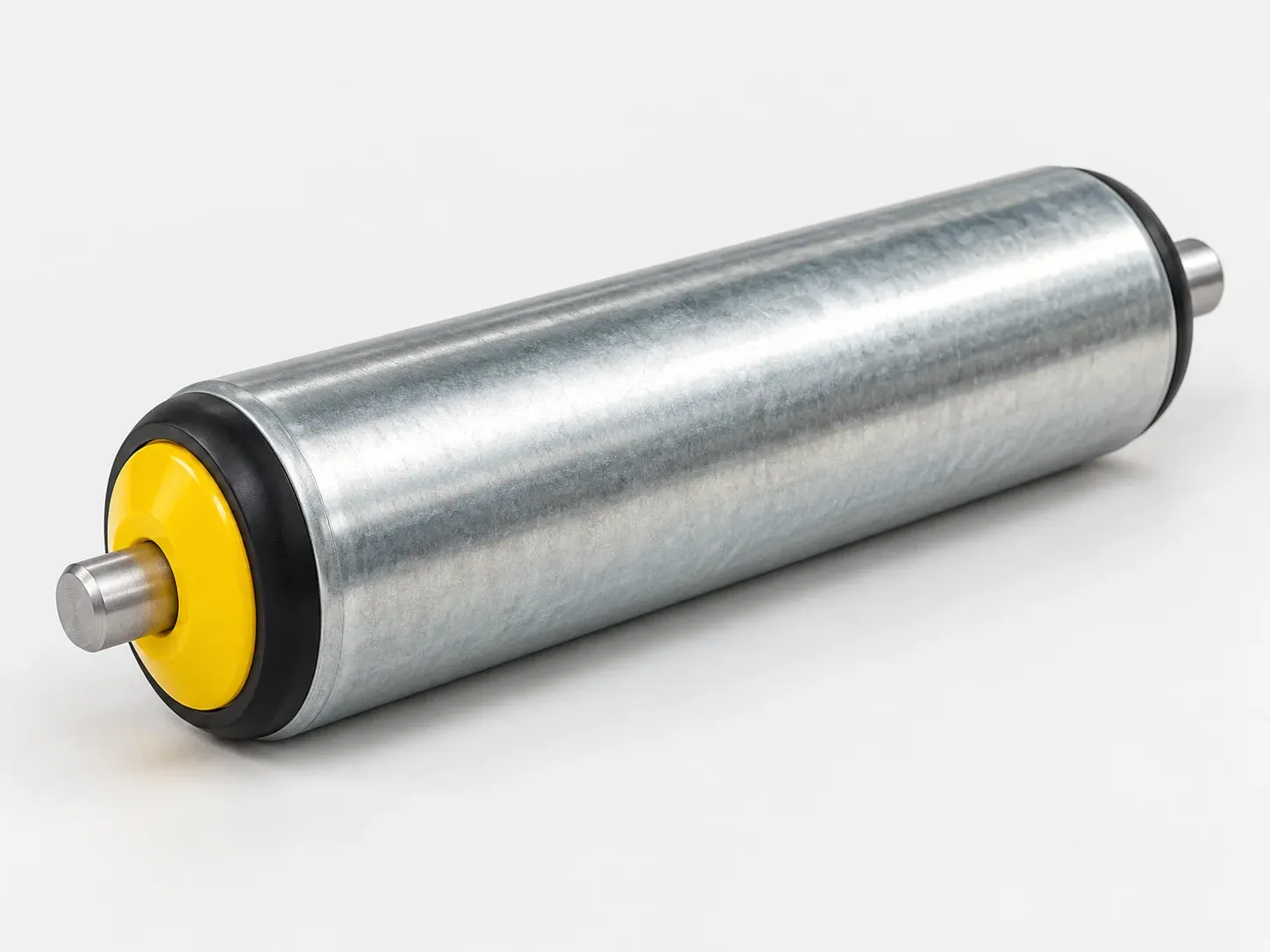
What you are actually choosing
A roller conveyor is a row of rollers in a frame. Everything else is a decision about three things: what rides on it, how it is pushed along, and what the building around it is like. Unpowered rollers suit hand-pushed lines or lines laid on a slight incline. Driven rollers, by chain or belt from a motor, keep a line moving continuously. Motorised rollers, which carry their own low-voltage motor, split the line into zones that start and stop on demand and are the usual choice for accumulation and sorting.
Our range at a glance
| Option | Typical choice | Good for |
|---|---|---|
| Roller diameter | about 38 to 89 mm | Light cartons up to pallets |
| Tube material | Galvanised steel, stainless steel, aluminium, plastic | Dry, washdown, light-duty, corrosive |
| Light-duty load per roller | about 30 to 150 kg | Parcels, totes; heavier needs thicker tube |
| Drive | Plain, chain or belt driven, 24 V DC motorised | Manual, continuous, zoned lines |
| Line speed | about 0.1 to 0.5 m/s on accumulation and sorting lines | Distribution and packing |
| Sections | Straight, curved with tapered rollers, inclined | Layouts with turns and level changes |
These are general class values; the general-purpose conveyor rollers and roller modules are rated for the exact roller or module quoted, and a rating on one roller is not a rating for a whole line.
Four decisions that matter
Pitch. Set it from the shortest item you carry. Three rollers under the load is a sensible minimum for stable travel.
Roller strength. Heavier loads need larger diameter, thicker tube wall and a stronger axle. A cheap thin roller on a pallet line is the classic failure, and the damage shows as bent tubes and noisy bearings.
Drive. Hand-pushed or gravity lines cost the least. Powered lines add control. If you want accumulation without pressure between items, say so early, because it changes the roller type.
Environment. Dust, moisture and cold change the material and the bearing seals. Sealed ball bearings are normal on our range.
Maintenance is modest but not zero. Sealed bearings last longer in dusty or wet plants, chain-driven sections need lubrication and guards, and motorised rollers cost more at purchase but need very little service. Keep a few spare rollers and any drive belts or chains on the shelf, since wear concentrates at the load contact and in the bearings.
Rollers are a component of a bigger system. If your project also involves relocating production machinery, see machine skates, or return to material handling for the whole category.
What to send for a quote
- What the line carries: dimensions, weight and base type of the smallest and heaviest item
- Line length, width between frames, and any curves or inclines
- Powered or unpowered, and the speed or throughput required
- Power supply in your country (voltage and frequency)
- Operating environment: dust, wet, cold, washdown
- A sketch of the layout and where items enter and leave
A drawing of the layout and a sample item size is enough to start; send it through the contact page.