Where ammonia plants make sense
Ammonia is a natural refrigerant with zero ozone depletion and zero global warming potential, and it has very high latent heat, so a plant can move a lot of heat per kilogram of charge. It is toxic, so it belongs in engineered plants with a machine room, gas detection and trained operators, not in small shops. The usual customers are large food cold stores, frozen logistics warehouses and process cooling in food and beverage factories.
What is in the plant
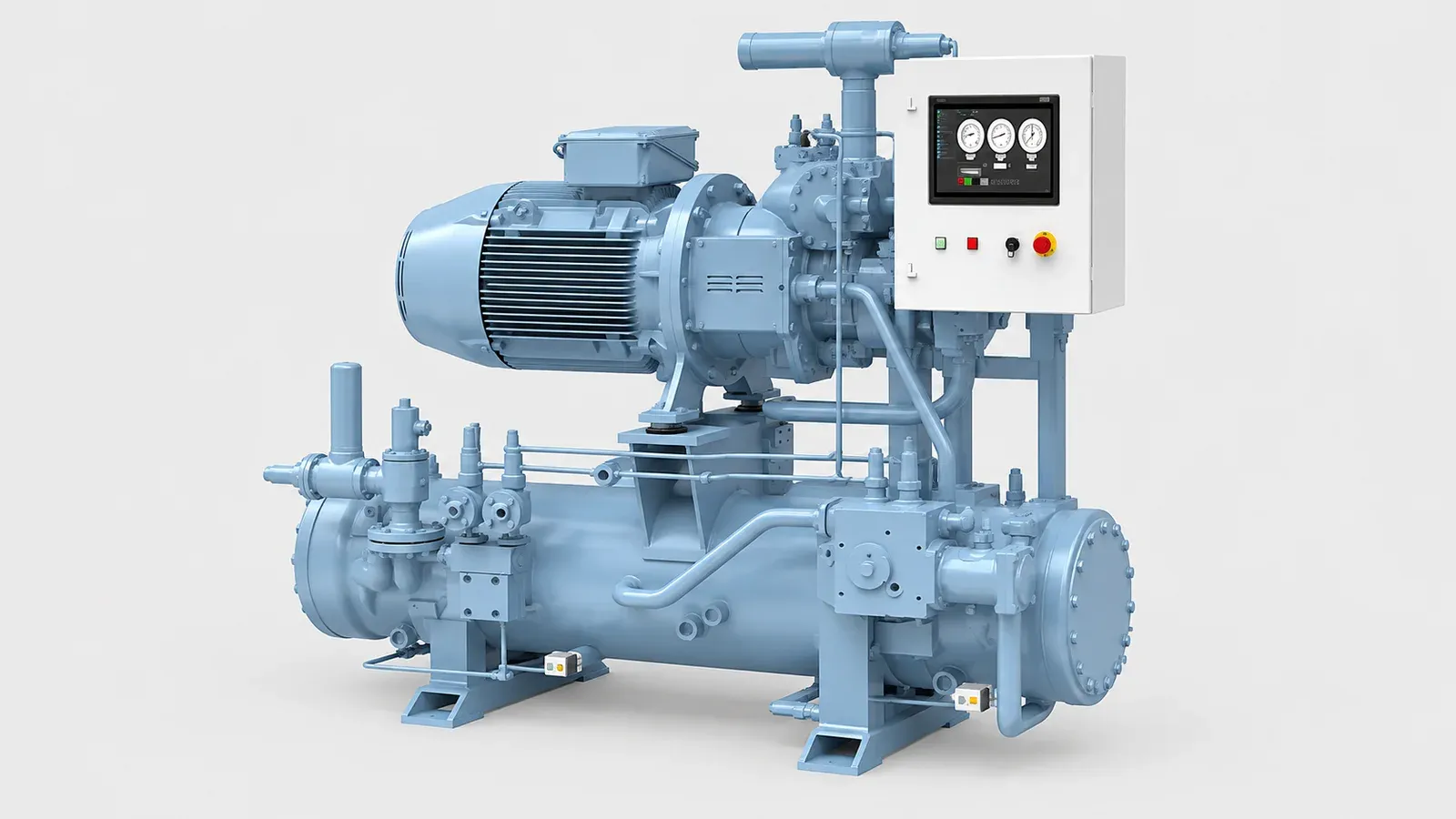
A system has compressors, condensers, receivers, a pump station, evaporators and a control panel. Our industrial ammonia refrigeration system lists piston or screw compressor packages, evaporative or water-cooled condensers, pump recirculation or direct expansion, and carbon steel welded piping with insulated cold lines. Typical evaporating temperatures run from about -40 to +5 °C by application, and condensing at about 30-40 °C.
| Choice | Option | Leans towards |
|---|---|---|
| Compressor | Screw package | Large, steady loads |
| Compressor | Piston package | Smaller or varied loads |
| Feed | Pump recirculation | Large evaporator banks, low-temperature stores |
| Feed | Direct expansion | Smaller charge, simpler plant |
| Condenser | Evaporative | Best efficiency where water is available |
| Condenser | Water-cooled | Sites with a cooling tower or river water |
Sizing from the heat load
Capacity follows the product and building: daily throughput, entering temperature, required end temperature, room losses, door traffic, fans and defrost. Our range covers roughly 100 kW to several MW. Do not size from floor area. Give us the loads or the products and we calculate them, then set the suction temperature the freezers need, since that decides the compressor stages.
Ambient design temperature drives condensing pressure. A site at 40 °C in the shade needs a larger condenser than one at 25 °C. Also state your electrical supply, because compressor motors are specified for voltage and frequency.
Planning the machine room
The compressor package, receivers and pump station sit in a dedicated machine room with ventilation. Plan floor loading, drainage, and a clear exit route. Pipework runs on racks above the process area, with insulated cold lines and defrost provision. Hot gas defrost is available as an option on low-temperature evaporators. Variable-speed drives on compressors help when the load swings between day and night shifts.
Safety and regulation
Our plants come with ammonia sensors alarming at about 25 and 150 ppm, and options include machine room ventilation and an emergency diffusion tank. International standards such as ASHRAE 15, EN 378 and ISO 5149 set design and safety requirements, and the IIR paper concludes they provide adequate control when followed. Check local limits on ammonia charge before you finalise the design.
For smaller storage needs, a packaged cold room is simpler. The sizing method in our cold room guide also shows how load is estimated.
What to send for a design
- Cooling load, or products and daily throughput
- Required temperatures: freezing, chilling or both
- Site location and ambient design temperature
- Condenser preference: air, evaporative or water
- Local rules on ammonia charge
- Power supply and controls requirements
We then return a design basis and equipment list for review.