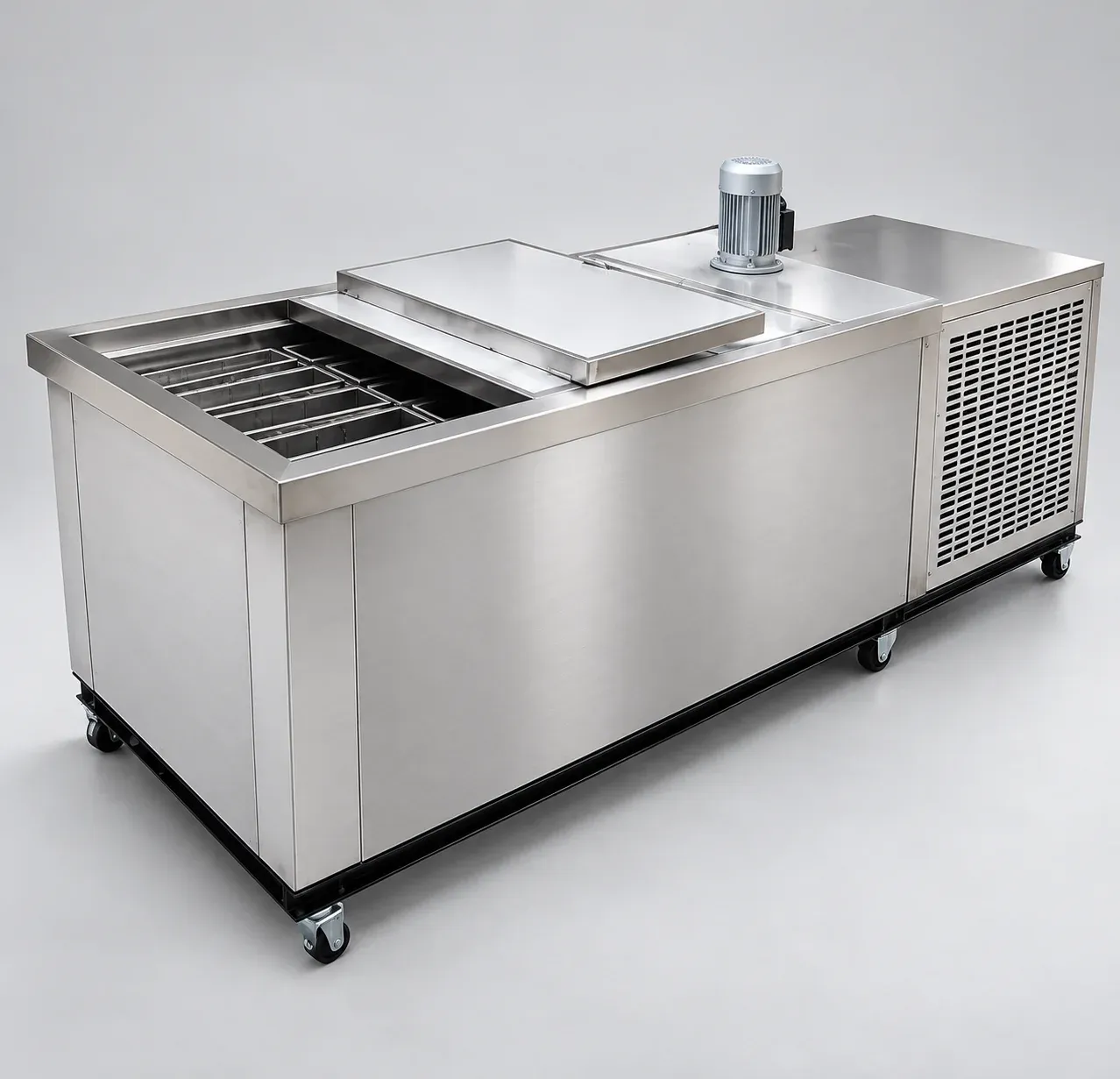
Which ice form fits the job
Ice machines are classed by the ice they make: block, flake, plate, tube and slush. Flake and plate ice cool fast on contact and suit processing and fish holds. Block ice cools slowly, travels well and is easy to store and carry, which is why FAO notes it still has an advantage in tropical countries. Our listed range is block ice, made by an indirect brine system.
| Ice form | How it is made | Best for | Handling |
|---|---|---|---|
| Block | Cans or molds in cold brine, 8-24 h on large plants | Fish landing, transport, small ice sellers | Needs hoist or lifting, easy to stack |
| Flake | Scraped from a cooled drum | Fish on board, processing, bakery | Needs a bin and conveying |
| Tube or plate | Frozen then released by defrost | Packing houses, retail | Automatic, wetter ice |
Our block ice range
The compact brine-type block ice machine comes in three outputs, 500, 1,000 and 2,000 kg per 24 h, with a SUS304 brine tank and molds, and 5 kg or 10 kg blocks. Brine is a salt solution of about 20-23% sodium chloride at roughly -8 to -12 °C. A 5 kg block freezes in about 3-5 hours and a 10 kg block in about 5-8 hours.
Connected power runs about 5-15 kW across the three sizes. The compressor is semi-hermetic or scroll, air- or water-cooled; water-cooled needs a cooling tower or mains water. Confirm voltage, frequency and phase for your site before ordering.
Sizing without guesswork
- Decide the daily ice in kilograms, including melt in transit.
- Choose block weight: 5 kg is easier to carry, 10 kg lasts longer in a box.
- Check water temperature and quality; hard water means scale and may need softening.
- Plan block handling and storage, since a few tonnes of ice per day needs space and a cold room.
If you also need somewhere to keep the ice, pair the machine with a cold room. Very large daily tonnage is a plant job; see industrial refrigeration.
Brine, tank and mold details
Because heat leaves each mold through the brine, the tank is kept agitated so the temperature is even from the first mold to the last. FAO points out that freezing too quickly gives brittle ice, and a thicker block takes longer; that is the reason block weight is a real choice rather than a catalogue detail. Our 10 kg block is slower than the 5 kg one but stays intact longer when stacked in a fish box or truck.
Water and climate
Ice quality follows water quality, so share a water analysis if you have one. Hot sites lower capacity; the quote will state output at your ambient and water temperature, not only at the test point. Salt brine is corrosive to ordinary steel, which is why the tank and molds are stainless.
What to send for a quote
- Ice per day and block weight
- Ambient and water temperature
- Water source and quality
- Voltage, frequency and phase
- Air or water cooling preference
- How blocks will be stored and moved
This is enough for us to quote the right size and handling kit.